
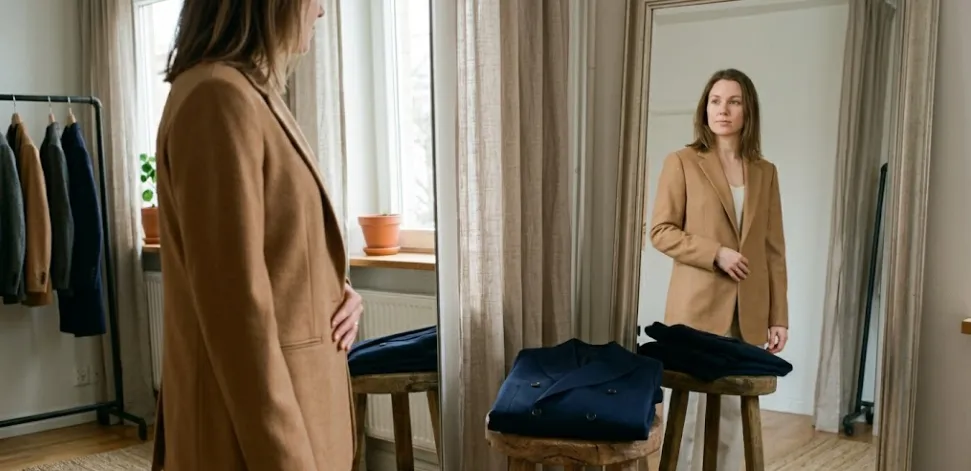

There is a blazer I wore for the last eighteen months of my time at Vogue that I now think of as a kind of evidence.
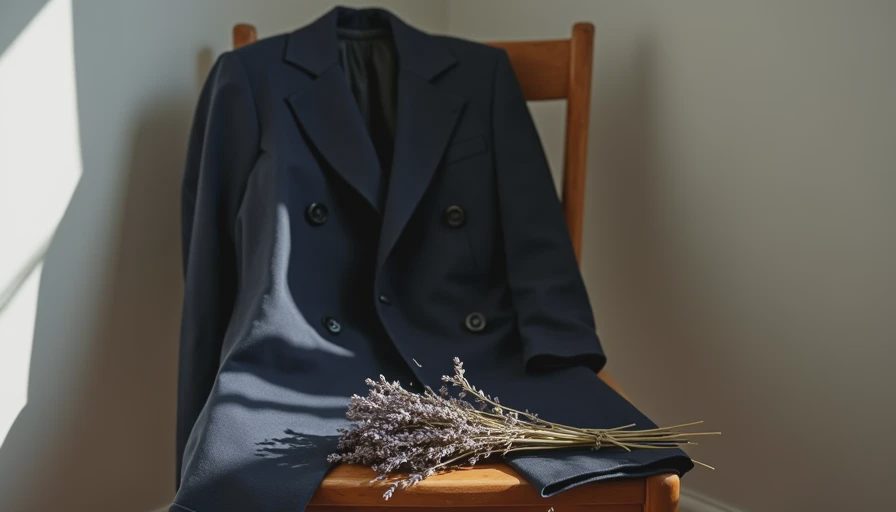
It was a double-breasted wool crepe blazer in a very dark navy — almost black in most lighting, which was, I suspect, part of the appeal. Structured to the point of rigidity. Shoulder seams that sat exactly where shoulder seams are supposed to sit, with a precision that left no room for ambiguity. I wore it to editorial meetings, to difficult conversations with difficult people, to the specific kind of professional situations where I needed, above everything else, to feel impenetrable.
It worked, in the narrow sense that armor works. Nobody questioned me when I was wearing it. Nobody pushed too hard or assumed too much. I walked into rooms and the room responded accordingly.
What I did not understand at the time — what I understand completely now — is that I was not dressing for authority. I was dressing against vulnerability. And those two things produce very different results, in clothing as in life.
The blazer was not power. It was defense. And the distinction, once you see it, is impossible to unsee.
The Problem With Power Dressing as We Inherited It
The visual language of women's professional dressing has a complicated history that I do not intend to fully excavate here, but that I think deserves honest acknowledgment.
The version of power dressing that most of us absorbed — through the 1980s silhouettes that lingered well into the following decades, through the implicit dress codes of corporate environments, through the cultural shorthand of "dress for the job you want" — was largely built on a single premise: that female authority needed to be legible in a visual language borrowed from male professional dress.
The wide shoulder. The dark, uninterrupted color. The structured silhouette that read as serious precisely because it suppressed the softness it associated with femininity. The overall message, stated without being stated: I have edited myself into something you will take seriously.
I wore versions of this for years. Many of us did. And I am not interested in dismissing it entirely, because I understand the survival logic that produced it, and because there are professional contexts — specific industries, specific moments — where a certain degree of visual severity is still, unfortunately, strategically necessary.
But I want to talk about what it costs. Because it costs something.
Dressing against yourself — against your own aesthetic instincts, against the way you actually want to move through the world — is a form of chronic low-level expenditure that accumulates across a working life. It is one of those things that you don't notice paying until you stop, and then the relief is so complete that you understand, retrospectively, how much it was taking.
The soft power blazer is my answer to that expenditure. Not an abandonment of professionalism. Not a retreat from the need to be taken seriously. Something more considered than either of those things.
What I Mean by Soft Power, Specifically
I want to be precise about this term because it is used loosely in fashion writing and I think the looseness obscures something useful.
Soft power, in the context I am using it, does not mean feminine, or pretty, or non-threatening. It does not mean unstructured in the physical sense — some of the most effectively soft-power blazers I own have considerable internal structure. It does not mean casual, or relaxed in the way that word is sometimes used as a euphemism for less professional.
Soft power, as I mean it, is the capacity to convey authority without requiring the room to submit to you. It is presence without aggression. It is the confidence that does not need to announce itself because it is not, at its root, performing for an audience.
In blazer terms, this translates to specific and learnable qualities. Let me walk through them directly.
The Five Qualities of a Soft Power Blazer
One: The Shoulder Should Follow Your Body, Not Precede It
The shoulder seam is the single most important structural element in a blazer, and it is where the difference between armor and authority is most physically visible.
A severe blazer shoulder extends the line of your body outward and upward, creating a silhouette that reads as deliberately imposing. This is not inherently wrong — there are moments and contexts where that imposition is the point. But in most professional environments I have navigated, and certainly in the post-burnout working life I am building now, that imposition creates a subtle but real distance between you and the room.
A soft power blazer shoulder sits at the natural end of your shoulder — neither extended beyond it nor falling inside it. The seam follows rather than leads. The result is a silhouette that reads as composed rather than fortified, and that invites rather than forecloses the kind of professional engagement that actually gets things done.
When trying blazers, I press two fingers gently against the shoulder seam and check whether it sits at the precise edge of my shoulder bone. If it extends beyond, the blazer is sending a message I no longer want to send.
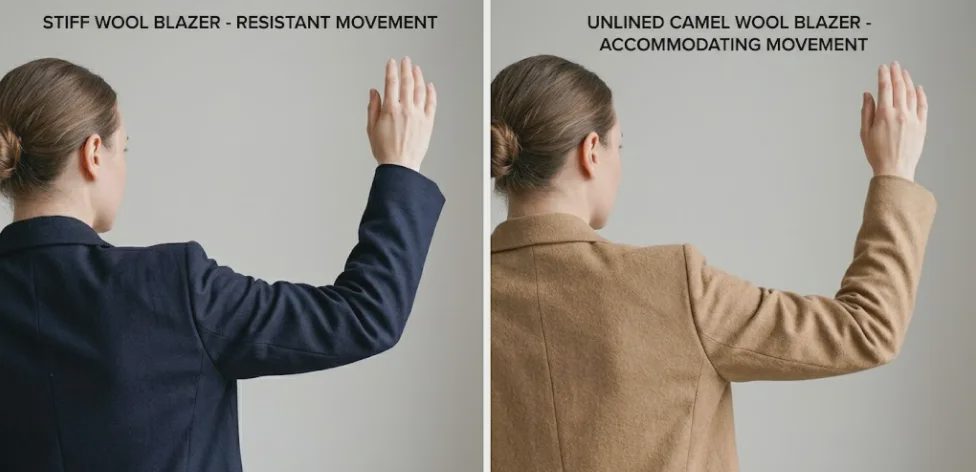
Two: The Fabric Should Move When You Move
This is where most severe blazers fail, and where most soft power blazers succeed.
A blazer that is constructed to maintain its shape independently of the body inside it — which describes most traditionally structured suiting fabric — reads as a carapace. You are wearing it. It is not wearing you. The visual effect is one of containment, which can read as control but more often reads, to a perceptive room, as tension.
The fabrics I return to most consistently for soft power blazers are: unlined or half-lined wool flannel in lighter weights, which drapes with a warmth that structured suiting lacks. Bouclé, when it is properly constructed — not the loosely knitted costume version, but the tighter, more architectural bouclé that holds a shape while still breathing. Linen in heavier weights, particularly for warmer seasons and creative professional environments. And increasingly, cashmere-blend coatings that function as blazers in terms of proportion but feel entirely different against the body.
All of these fabrics have one quality in common: they move in response to the body rather than in spite of it. The authority they convey comes from ease rather than rigidity.
Three: The Color Should Be Confident Without Being Aggressive
Color in a professional blazer is a conversation about how much work you are asking your clothing to do on your behalf.
Very dark, very saturated, or very high-contrast colors in a blazer context are doing a specific kind of work: they are creating visual boundaries, establishing the edges of your professional presence in space. This is sometimes useful. It is not always necessary.
The colors I find most consistently effective for soft power dressing are what I would describe as colors with depth rather than volume — camel, warm taupe, slate blue, a particular kind of olive that reads as sophisticated rather than casual, dusty rose in the right context, and a warm mid-grey that works across almost every professional environment I have encountered.
These colors are not neutral in the sense of being absent. They are present in a way that does not compete with the room. They suggest aesthetic confidence — a woman who made a considered choice — without requiring the room to organize itself around her.
Four: The Lapel Should Be Considered, Not Oversized
Lapel size is one of those details that registers subliminally even when it is not consciously noticed, and it is one of the primary visual signals that separates a soft power blazer from a fashion statement.
Very wide lapels read as directional — they are referencing a specific moment in fashion history and asking the room to place them there. Very narrow lapels can read as overly corporate, or as a kind of visual austerity that tips into severity.
The lapel I return to most reliably is a medium notch lapel — wide enough to feel generous and considered, narrow enough to stay out of its own way. For softer, more creative professional contexts, a shawl collar can work beautifully. For more formal environments, a clean peak lapel in a non-oversized proportion reads as authoritative without being aggressive.
Five: The Fit Should Allow You to Forget You Are Wearing It
This is the criterion I consider most important, and it is the one that is hardest to evaluate in a fitting room, because it requires imagining yourself wearing the blazer across an eight-hour working day rather than for three minutes under fluorescent light.
A soft power blazer — any garment that is doing its job correctly, in fact — should disappear into the day after the first twenty minutes. You should not be adjusting it, accommodating it, or thinking about it. Your attention should be fully available for the work in front of you.
When I try a blazer, I sit in it for at least five minutes in the fitting room. I reach forward. I cross my arms. I turn and look over my shoulder. If the blazer asks for my attention at any point during these movements, it will ask for it all day. That is a blazer I do not buy, regardless of how it looks standing still.

The Brands I Return To
Because specificity is more honest than vagueness, and because I have direct experience with these:
Toteme makes what I consider the most reliably excellent soft power blazer at a contemporary luxury price point. Their tailoring is generous without being oversized, their fabrics are consistently honest, and their color palette aligns almost precisely with what I have described above. The single-button blazer in their wool flannel is a piece I recommend without reservation.
Arket for an accessible entry point — their unlined linen blazers in particular represent a quality-to-price ratio that I find difficult to improve upon at their price point. The construction is not couture, but it is honest, and the proportions are very good.
Officine Générale, for the woman who wants something with more personality and craft. Their fabrics are sourced with genuine care, and the fit reflects a French approach to tailoring that is inherently less severe than its Anglo-American counterpart.
Margaret Howell, always, for the version of professional dressing that has entirely left the need for external validation behind. Her blazers are for women who have figured themselves out. They reward that clarity.
What I Wear It With
The soft power blazer works hardest when everything around it is equally considered and equally free of effort.
My current combination, worn more times than I can accurately count: the blazer over a silk or cotton blouse with a placket rather than buttons, wide-leg trousers in a fabric that complements rather than matches, flat loafers or a low block heel depending on the day, no visible accessories beyond small earrings and a watch that I have worn for eleven years.
The overall effect, I am told, is one of someone who has made decisions and is comfortable with them.
That is, after everything, exactly what I was trying to say.
The Thing the Blazer Cannot Do
I want to close with an honesty that I think this kind of writing often omits.
The soft power blazer — or any blazer, or any garment — cannot do the interior work for you. It cannot create the confidence it is meant to express. It cannot resolve the specific and ongoing labor of learning, after burnout, to trust your own authority without the armor that the old way of working required.
What it can do is stop working against you. Stop asking you to perform a version of professionalism that costs more than it returns. Stop requiring you to be impenetrable in rooms where what you actually need is to be present.
The best professional clothing I have ever worn has this quality in common: it asks nothing of me except that I show up. The rest — the competence, the considered opinion, the genuine presence in the room — that is mine to bring.
The blazer just holds the space while I do it.
Dress for the life you are gently returning to.