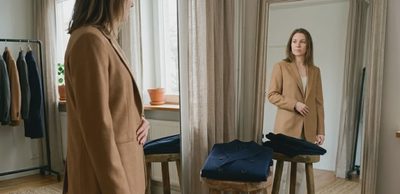


For a long time, I believed that dressing for work meant dressing for battle.
Not consciously. I wouldn't have used that word at the time. I would have said I was dressing professionally, dressing intentionally, dressing to command the room. But underneath all of that fluent industry vocabulary was something much more primitive: I was constructing a version of myself every morning that was designed to withstand scrutiny, deflect doubt, and signal — continuously, preemptively, exhaustingly — that I belonged.
The blazer was a shield. The heel was a claim. The perfectly chosen accessory was a credential.
And every single morning, before I had eaten breakfast or spoken a kind word to my husband or noticed whether the light was doing something beautiful outside our window, I had already gone to war.
I am done with that now. And I want to tell you exactly what I wear instead.
First, A Reframe: What "Professional" Actually Means
Here is something I learned from five years inside one of the most image-conscious editorial environments in the world: the women who were most consistently respected were rarely the ones who were most visibly trying.
There is a particular kind of professional anxiety that expresses itself through clothing — the outfit that is trying too hard, assembled from too many correct pieces, communicating effort rather than ease. I wore that outfit for years. I see it now in women who are where I used to be: talented, driven, slightly terrified, and dressed like they are auditioning for a role they've already been given.
Workwear after burnout requires a fundamental shift in the question you ask yourself when you get dressed.
The old question was: Does this make me look like I belong here?
The new question is: Does this allow me to actually be here — present, comfortable, capable, myself?
These sound similar. They are not. The first question is external and defensive. The second is internal and honest. And the clothes that answer each question look surprisingly different on the body.
What I Actually Wear Now: The Wardrobe Rebuilt From Stillness
I still care enormously about how I dress for work. I want that to be clear before I go any further, because I have no interest in the narrative that recovery from professional perfectionism means abandoning all aesthetic standards and living in linen trousers forever.
(Although I do own several pairs of linen trousers, and they are excellent.)
What changed is not the quality of what I wear. What changed is the relationship I have with it.
My current professional wardrobe is smaller than any I have kept since my early twenties. It is also more expensive on a per-piece basis, more thoughtfully assembled, and — for the first time in my adult working life — genuinely comfortable in a way that has nothing to do with the absence of structure and everything to do with the presence of intention.
Let me walk you through how I think about it.
The Pieces: Elegant Work Outfits That Ask Nothing of You
1. The Unstructured Blazer — Not the Armor Blazer
There is a blazer that announces itself, and there is a blazer that simply accompanies you. I spent the better part of a decade wearing the first kind. I now own only the second.
The distinction is in the construction. A heavily padded, sharply tailored blazer is a statement of intention — it broadcasts authority before you've said a word. For certain rooms, in certain seasons of life, that is exactly what you need. But if you have been using it to feel safe rather than to feel yourself, you will know. You will feel the weight of it differently.
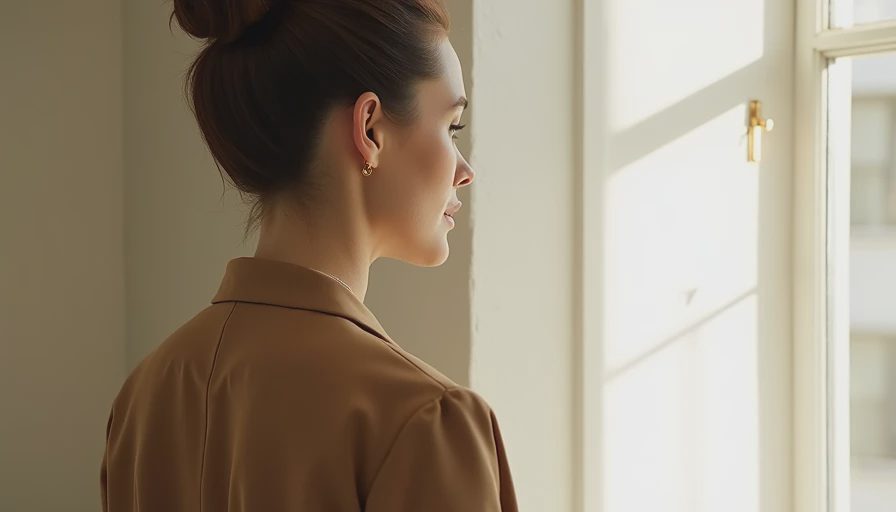
What I wear now: a mid-weight, unlined blazer in camel or ivory, cut slightly longer than the waist, with soft shoulders and a front that doesn't require buttoning to look complete. It works over a silk tank for creative meetings. It works over a fine knit for quieter writing days. It travels with me without losing its shape. It does not require me to brace myself when I put it on.
This is what quiet luxury workwear actually means to me — not a logo, not a price point, but a garment that functions with such quiet confidence that it asks nothing of your nervous system.
2. The Wide-Leg Trouser in a Serious Fabric
Somewhere along the way, professional culture conflated physical restriction with professional credibility. The tighter the silhouette, the more serious the intention. I absorbed this logic so completely that I once spent an entire twelve-hour shoot day in trousers that I couldn't comfortably sit down in.
I will not be doing that again.
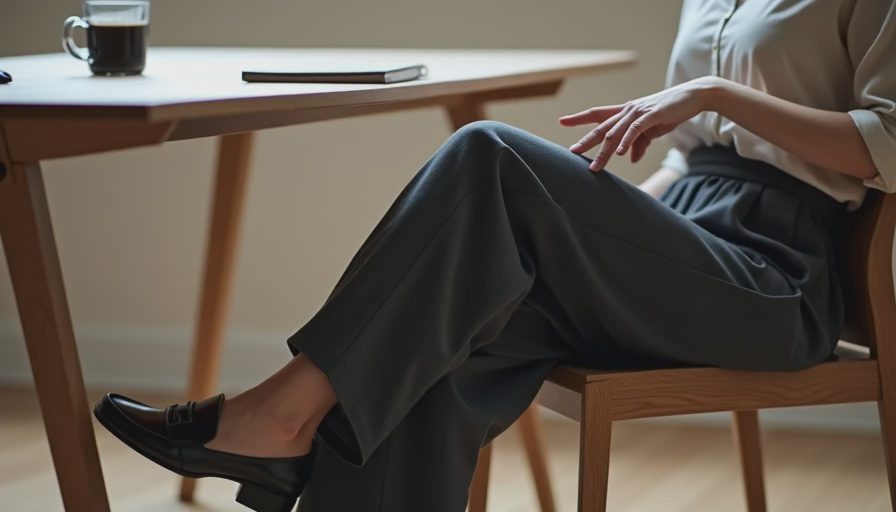
The wide-leg trouser — in wool crepe, in heavy silk, in a substantial cotton blend — is one of the most elegant and stress-free outfit foundations I know. It reads as deliberate rather than casual. It moves beautifully. It allows your body to exist in a chair, at a desk, on a long call, in a restaurant, without requiring continuous micro-adjustments of the kind that quietly drain your attention all day long.
My current preference: charcoal grey wool crepe, high-waisted, with a clean hem that breaks just at the shoe. Nothing about it whispers. Nothing about it shouts. It simply makes the rest of the outfit's job easier.
3. The Silk or Silk-Feel Blouse in a Quiet Neutral
I kept three blouses from my Vogue years and retired the rest. The three I kept share a quality I can only describe as ease. They are not precious. They do not require special handling of my mood or my morning timeline. They go on and they look right and they don't ask me to think about them again until I take them off.
For elegant work outfits for women who are rebuilding their professional identity after a period of exhaustion, I think the blouse is often the most important piece to reconsider. It is the most intimate — it sits closest to your body, it moves when you move, it is what people see when you are seated across from them for an hour.
If your blouse is uncomfortable, slightly wrong, or carrying the weight of someone else's idea of who you should be in a room, you will feel it in a way that slowly accumulates across a working day.
Find one that feels like a light hand on the shoulder. That is the only brief worth following.

4. The Shoe That Doesn't Demand Your Attention Back
I have made my peace with flat shoes. This took longer than I would like to admit.
Not because I believe heels are wrong — I still own two pairs that I love and wear with genuine pleasure. But I spent too many years wearing heels because they felt professionally necessary, which meant I spent those years managing my footwear instead of managing my work. A portion of my attention was always on the ground beneath me.
My current default for working days: a clean leather loafer or a low block-heeled mule in a neutral that doesn't compete with the rest of the outfit. They are shoes that have already solved their own problem and allow me to solve mine.
On Color, and What Your Nervous System Is Telling You
Workwear after burnout often involves a recalibration of color that is worth paying attention to, because it is rarely about aesthetics alone.
Many women I know, coming through difficult professional periods, find themselves gravitating toward a quieter palette without fully understanding why. Camel, ivory, grey, navy, the occasional deep olive. Not because these are the "correct" quiet luxury colors — though they are beautiful — but because they ask less of you emotionally on a morning when you have less to give.
This is not a sign of diminishment. It is a sign of intelligence.
When you have been living in a high-stimulation environment for years, your nervous system begins to treat visual noise as another tax. Dressing in a palette that feels genuinely calm is not giving up on beauty. It is defining beauty on terms that serve you rather than perform for others.
As you recover — and you will recover — you may find color returning naturally. A warm terracotta blouse that suddenly feels right. A deep burgundy coat that you wear all winter. Let it come back on its own timeline. Dressing for recovery is not a permanent aesthetic position. It is a practice of listening.
The Hardest Part: Dressing Capable Without Dressing Tense
I want to stay with this for a moment, because I think it is the real heart of what we are talking about.
The fear underneath performative workwear is always the same: if I stop trying this hard, will anyone still take me seriously?
It is a fair fear. I held it for years. And I will not tell you it has no basis in reality, because I have worked in enough rooms to know that appearance still carries weight in ways that are sometimes unfair and sometimes unavoidable.
What I will tell you is this: the women I have found most compelling in professional contexts — the ones whose intelligence and presence stayed with me long after meetings ended — were not the ones dressed most forcefully. They were the ones who appeared to be entirely, peacefully at home in themselves.
That quality is not manufactured by a blazer. But it can be supported by clothing that doesn't contradict it.
When you stop dressing for armor and start dressing for presence, something shifts in how you occupy a room. You stop performing capability and start demonstrating it. There is a difference, and people feel it, even when they cannot name it.
A Closing Note, From One Ambitious Woman to Another
I left one of the most recognized fashion institutions in the world. I am still ambitious. These two facts coexist in me every day, and I have stopped trying to resolve the tension between them.
What I have built instead is a wardrobe — and a working life — where ambition and ease are not enemies. Where looking capable does not require feeling tense. Where the first decision of my morning does not ask me to go to war before I've finished my coffee.
This is not a lesser version of a professional life. It is a more sustainable one.
Dress for the life you are gently returning to .