

Why Price Alone Cannot Guarantee Quality
There is a specific, quietly expensive disappointment that comes from a cashmere sweater that pills within its first winter. I’ve experienced it more than once, at prices that should have protected me — if price alone were a reliable measure of quality. It is not. This is the first thing I want to tell you.
The Hidden Variables: Fiber Diameter and Length
What Labels Won’t Disclose
Cashmere quality varies dramatically because it depends on two things no label discloses: fiber diameter and fiber length. The finest fibers feel soft but can be fragile; short-staple fibers — the industry’s cost-cutting compromise — are the main cause of pilling, because they migrate out of the yarn and tangle under friction. Since labels won’t tell you this, you must use your hands.
The Hidden Variables: Fiber Diameter and Length
What Labels Won’t Disclose
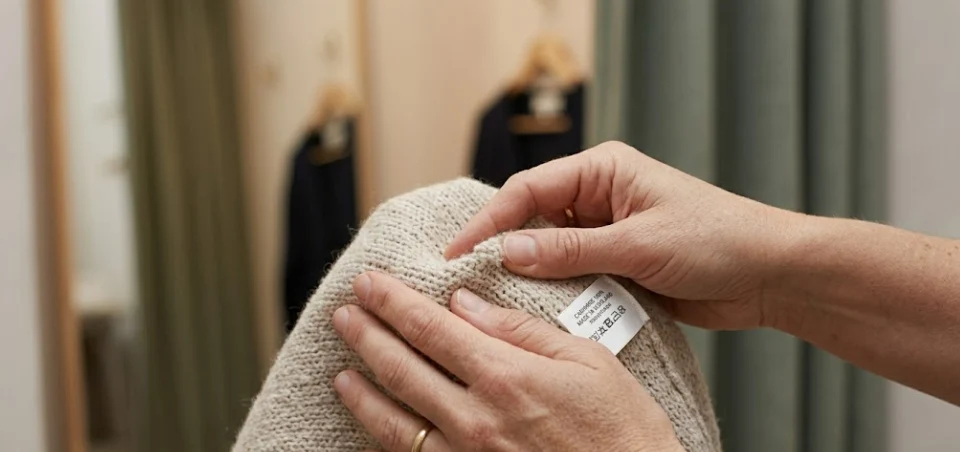
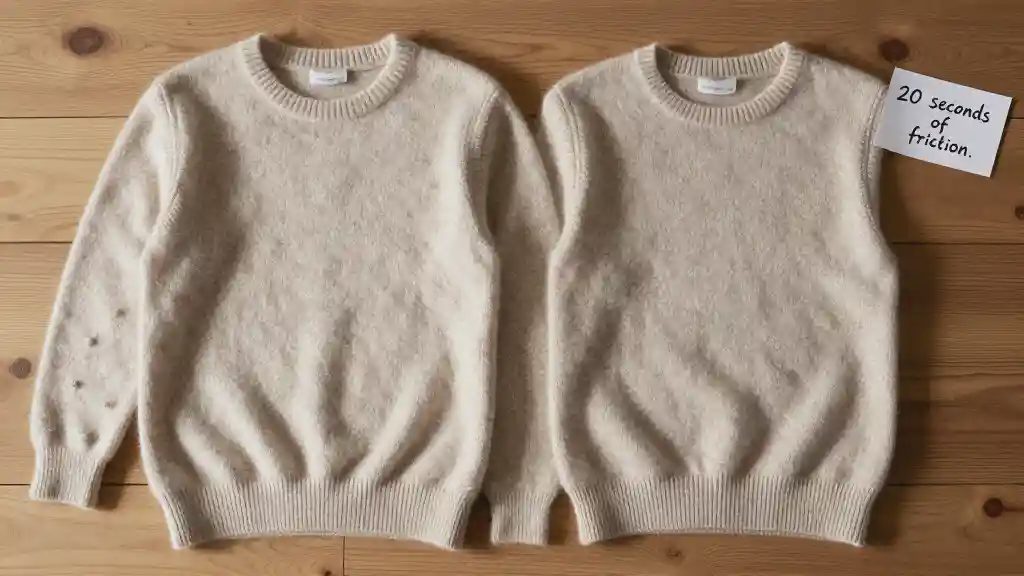
The rub test is the most immediately informative. Gently rub the sweater between your palms for about twenty seconds. If the surface begins to fuzz or tiny pills form, the fibers are too short. In a well-made, long-staple sweater, the surface will remain smooth. I’ve done this in fitting rooms across every price point; the results are more honest than any brand name.
The Stretch Test – Recovering Shape, Not Memory
The stretch test reveals structural integrity. Stretch the fabric gently at the side seam by about an inch, hold five seconds, then release. Quality cashmere recovers its shape within a second or two. If it doesn’t, the sweater will bag at the elbows and lose its shape by spring.
The Stretch Test – Recovering Shape, Not Memory
The drape test is simpler: lift the sweater by one shoulder and let it hang. Good cashmere has a dense, quiet weight and falls with intention. Lightness that feels airy for its thickness often signals a loose yarn or undisclosed blend. Hold the fabric up to natural light — consistency in the knit tells you what care went into it.

The Price Threshold and Its Illusions
Below It, Impossible; Above It, Unreliable
Below a certain price, good cashmere is economically impossible — the raw fiber alone costs too much. Above that threshold, price tells you very little. I’ve found sweaters at four hundred dollars that fail the rub test. The physical tests become essential. When you find a sweater that passes them all, care for it simply: hand wash cool, press in a towel, dry flat, fold in a drawer. Use a cashmere comb for the early-season pills that are normal even in good fiber.
After the Purchase: Simple, Disciplined Care
Washing, Drying, Storing – and Combing What’s Normal
What you are really buying is not softness. It is the quiet, unhurried experience of putting on the same sweater, in November, for the seventh year, and finding it unchanged. That begins with twenty seconds of gentle friction in a fitting room. Everything after that is patience.
What You Are Really Buying
The Seventh November, Unchanged
What you are really buying is not softness. It is the quiet, unhurried experience of putting on the same sweater, in November, for the seventh year, and finding it unchanged. That begins with twenty seconds of gentle friction in a fitting room. Everything after that is patience.