


For most of my twenties, I believed I had excellent taste.
Looking back now, with the particular clarity that only distance provides, I can see that what I actually had was excellent anxiety — and that I had trained it so thoroughly, dressed it so convincingly in the language of discernment and aesthetic intelligence, that I had become genuinely unable to tell the difference.
This is not a small confusion. It shaped nearly every decision I made for the better part of a decade — what I bought, what I wore, what I allowed myself to keep, what I discarded because it no longer felt sufficiently right, what I coveted in other women's wardrobes, what I said in meetings, what I left unsaid. The anxiety was so fluent in the vocabulary of taste that it passed, continuously and convincingly, as the real thing.
It took burning out completely — leaving a career I had spent years building, sitting very still in a Brooklyn apartment with nowhere to be and no one to perform for — to finally feel the difference in my body.
And once I felt it, I could not unfeel it.
What Taste Actually Is
I want to start here, carefully, because I think the word is used so loosely in fashion spaces that it has lost most of its useful meaning.
Taste, as I now understand it, is not a set of preferences. It is not a consistent attraction to certain colors, silhouettes, or price points. It is not the ability to identify quality, or to know the difference between a well-cut garment and a poorly cut one, or to recognize which pieces will age with grace and which will date in two seasons.
All of those things are skills. They are learnable, refinable, and genuinely valuable. I spent years developing them, and I am glad of it.
But taste — real taste — is something quieter and more foundational than any of that. It is the capacity to know what you actually love, independent of what you are supposed to love.
It requires a relationship with your own responses that is prior to and independent of external validation. It asks: not what do I think I should find beautiful, but what do I, in fact, find beautiful — and can I hold that knowledge steady when the room around me suggests otherwise?
This is harder than it sounds. Particularly if, like me, you spent formative professional years inside an institution where taste was both currency and social contract — where the ability to align your responses with the room's consensus was professionally rewarded, and deviation, however subtle, was noted.
What Fashion Anxiety Actually Is
Fashion anxiety is what happens when the external pressure to have the right response becomes louder than your internal one.
It presents itself in many forms, and I have practiced most of them at some point. The need to research a purchase exhaustively before committing, not out of genuine consideration but out of a terror of being wrong. The compulsion to qualify every aesthetic statement — I know this isn't very fashionable right now, but — before anyone has had the chance to disagree. The chronic dissatisfaction with a wardrobe that is, by any objective measure, more than sufficient. The restlessness. The sense that something is always slightly off, that the right thing is always just one more purchase away.
There is also the more socially visible form: the person in the room who always knows what is correct. Who can tell you, with precision, which brands are having a moment and which have crested, which silhouettes are arriving and which are leaving, what the well-dressed woman is wearing this season and how it differs from what she was wearing last season.
I was that person for years.
And I can tell you, from the inside, that it is an exhausting place to live. Because the knowing is never actually complete. The landscape keeps shifting. The goalposts are by design unmovable, because fashion's entire economic model depends on the insufficiency of what you currently own.
If you are always certain about what is correct, and that certainty requires continuous updating to maintain, you are not operating from taste. You are operating from anxiety that has learned to dress itself in the language of authority.
The Moment I Finally Understood the Difference
There was a specific afternoon, about six months after I left Vogue, when I understood this in a way that went beyond intellectual recognition.
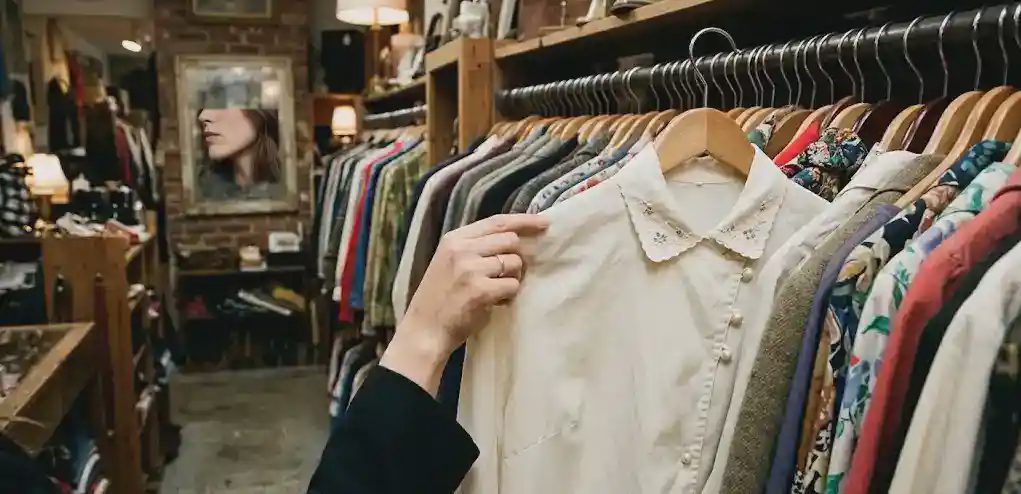
I was in a small vintage shop in our neighborhood — the kind of place with no particular curation philosophy, just a dense and slightly chaotic accumulation of things from various decades, various budgets, various lives. I was not looking for anything. I had nowhere to be. I was simply there, in the particular aimless way that became possible once I stopped filling every hour with productive intention.
I found a blouse on a crowded rail near the back of the shop. Cotton, ivory, with a small embroidered collar and a placket that buttoned to one side rather than the center. It was from no brand I recognized. It was not consistent with anything I would have described, at that point, as my aesthetic. It was seven dollars.
I loved it immediately. Completely, quietly, without needing to think about it.
And then I noticed what happened next — the old reflex, arriving within seconds. Is this right? Is this the kind of thing a woman with my background should be wearing? Is this consistent with the wardrobe I have been building? What would this say about me to someone who knew what I knew?
The questions came so quickly and so automatically that they nearly overwhelmed the original response.
But this time — for the first time, really — I noticed them arriving. I watched them come. And I recognized them for exactly what they were: anxiety in a trench coat, pretending to be discernment.
I bought the blouse. I have worn it more times than I can count. It is, without question, one of my favorite things.
The taste was the first response. Everything that followed was the anxiety.
How Burnout Clarifies the Distinction
I am not recommending burnout as a path to self-knowledge. The price is too high and the route is too painful, and if there is any way to learn this more gently, please take it.
But I will say this honestly: the period following my departure from the industry gave me something I had not been able to access while I was inside it. It gave me quiet.
Not just logistical quiet — fewer meetings, fewer deadlines, fewer rooms full of people whose opinions I had assigned significance to. But internal quiet. The slow, disorienting, eventually clarifying absence of the continuous noise that had, for years, made it impossible to hear my own responses.
When you have been living inside a high-stimulation environment for long enough, you lose the ability to distinguish your own signal from the surrounding noise. Your preferences become entangled with the preferences of the institutional culture you inhabit. Your taste becomes a negotiation between what you genuinely love and what the room rewards you for loving.
Burnout recovery, among other things, is the process of slowly disentangling those two things. Of sitting still long enough — in a quiet apartment, in slower mornings, on long walks with no destination — to hear what you actually think.
This is not comfortable. There is a period, early in that process, where the silence feels like emptiness rather than clarity. Where you reach for the old external references and find them no longer available, and you don't yet trust your own responses enough to substitute them.
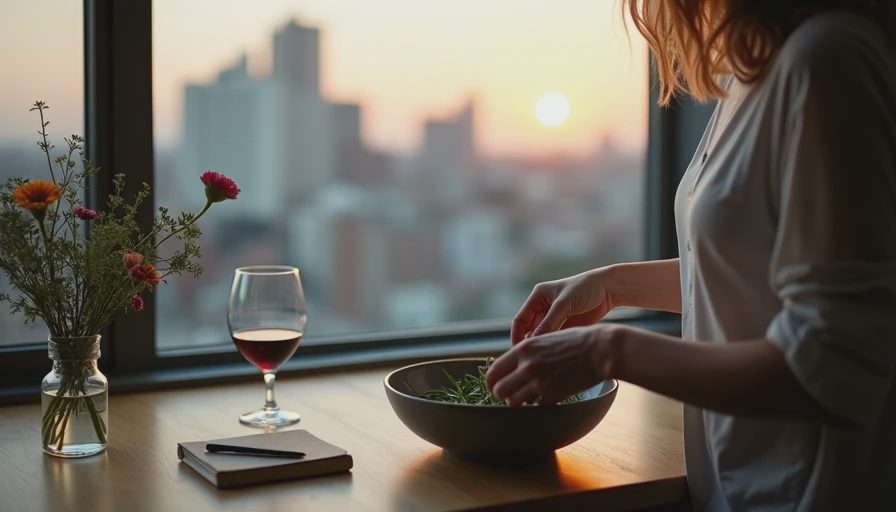
I kept fresh flowers on the table during that period. I cooked slowly. I watched old films — the ones nobody was talking about, the ones I chose purely because something in me wanted them. I noticed what I reached for when no one was watching, and I began, carefully, to trust it.
The Practical Difference, In a Wardrobe Context
Because this is ultimately a blog about clothing, and because I believe that abstract insights are only as valuable as their practical application, let me bring this back to the wardrobe.
Taste, in practice, looks like this: You enter a store, or you open a browser, or you stand in front of your closet, and somewhere in your body — not your head, your body — you have a response to what you encounter. A pull, or a stillness, or a quiet recognition. This response arrives before the analysis. It does not require research or confirmation. It simply is.
You may choose not to act on it. You may decide, after reflection, that the piece doesn't serve your life or your budget or the specific wardrobe you are building. That is judgment, which is taste's useful companion. But the original response — that is the thing worth trusting.
Anxiety, in practice, looks like this: The analysis comes first. The questions about correctness, about consistency, about what this purchase says about you and whether it aligns with the aesthetic identity you are trying to project. The exhausting triangulation between what you want, what you should want, and what wanting the right thing says about the kind of person you are.
The purchase may be made, or it may not. But either way, the process is draining rather than nourishing, and the result — whether you buy or walk away — rarely brings the peace you were looking for.

Learning to Trust the First Response
I am still practicing this. I want to be honest about that.
The reflexes of a decade do not dissolve in two years of quieter living. There are still mornings when I stand in front of my wardrobe and feel the old anxiety beginning its familiar inventory — the assessment, the second-guessing, the subtle sense that whatever I choose will be somehow insufficient.
When that happens, I try to do one thing: I go back to the first response. Before the analysis started. Before the questions arrived. What did I actually reach for? What did my hand move toward before my head intervened?
That, I have come to believe, is the beginning of genuine taste. Not the sophisticated vocabulary. Not the industry knowledge, though I am grateful for it. Not the ability to identify quality or recognize provenance or understand the history of a silhouette.
The beginning of taste is the willingness to trust yourself in a room full of beautiful things — and to hold that trust steady even when nothing around you confirms it.
That is the work I am doing now. Slowly, imperfectly, with fresh flowers on the table and a small notebook by the bed and the particular patience of someone who has finally learned that the most important things cannot be rushed.

Dress for the life you are gently returning to.