
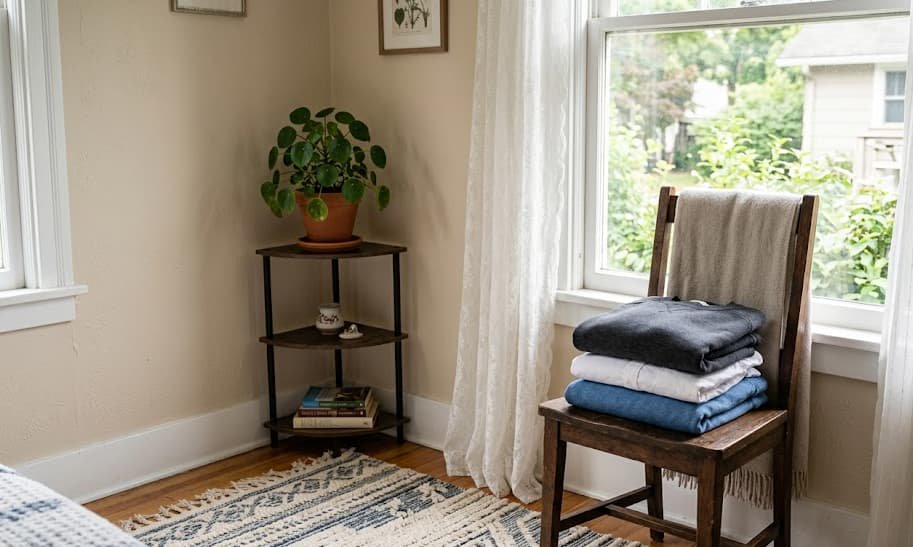

There was a pile of clothes in the corner of my bedroom that I did not touch for almost two years.
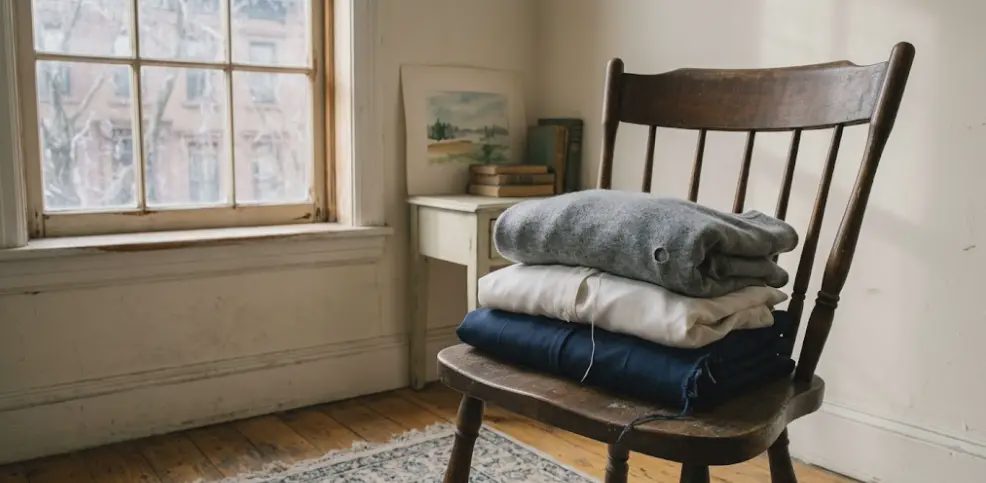
It was not a large pile. A cashmere sweater with a small hole at the elbow. A silk blouse missing two buttons at the cuff. A pair of wool trousers with a hem that had come undone along three inches of stitching. A linen dress with a torn side seam, the result of catching it on a door handle during a rushed morning I no longer remember. These were not ruined things. They were not beyond saving. They were simply waiting — folded, patient, slightly dusty — for a version of me that was willing to sit down and tend to them.
That version of me took a long time to arrive.
I walked past that pile every day. Some mornings I would glance at it and feel a small, sharp pang of guilt. Other mornings I would not see it at all — it had become part of the furniture, part of the background noise of my apartment, part of the accepted disorder of a life I was too depleted to fully manage. I was not lazy. I was not careless. I was recovering from burnout, and the mending pile, I now understand, was a quiet, accurate barometer of my mental state. It measured not how much I cared about my clothes, but how much energy I had left for acts of care at all.
What I did not know then, and what I want to write about now, is that the day I finally sat down with a needle and thread was the day I began to believe I might actually be getting better.
The Weight of the Undone
There is a particular weight that accumulates around small, undone tasks. Each one is trivial on its own — a missing button, a loose hem, a split seam. But together, over time, they become something heavier. They become evidence. Evidence that you are not keeping up. Evidence that you are falling behind in the smallest, most basic responsibilities of owning things and taking care of them. Evidence that you are, in some quiet and persistent way, failing.
This is not a rational assessment. It is an emotional one, and it is more powerful than reason. I could tell myself that the mending pile did not matter, that I had more important things to worry about, that no one was judging me for a torn hem. All of these things were true. But the pile remained, and every time I saw it, it whispered something else: You cannot even take care of your own things.
During the worst months of my burnout — the months after I left Vogue, when getting out of bed felt like an athletic achievement and making coffee felt like a project — the mending pile grew slowly and I did not question it. I was surviving. Surviving leaves little room for needle and thread. I gave myself permission to let the pile exist, and that permission was necessary and kind.
But there came a point, much later, when the permission began to feel less like kindness and more like stagnation. The pile had stopped being a symptom of my exhaustion and had started being a contributor to it. Every time I saw it, I felt a little worse. Every time I walked past it, I confirmed a story I was telling myself: that I was not the kind of person who mended things. That I was the kind of person who let things fall apart.
The Afternoon I Finally Sat Down
It was a Sunday in late January. I remember the light — the thin, watery light of a Brooklyn winter afternoon, the kind that makes you want to stay inside and do something quiet with your hands. My husband was reading on the sofa. The apartment was still. And for reasons I cannot fully explain, I walked over to the pile, picked up the cashmere sweater, and carried it to the kitchen table.
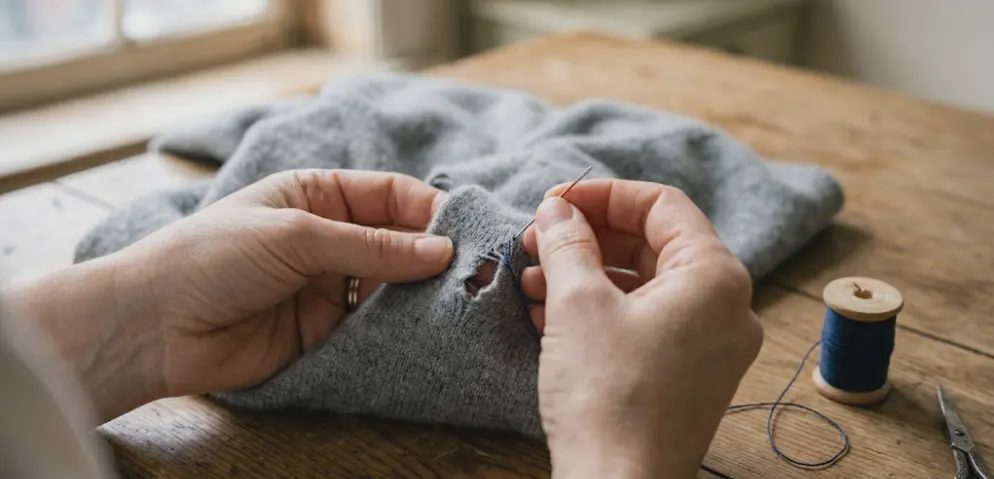
I threaded a needle. I found a spool of navy thread that matched the sweater almost exactly. I turned the sleeve inside out and looked at the hole — a small, clean tear at the elbow, probably from catching it on something sharp. It was not complicated. It would require perhaps six stitches.
I had not sewn anything in years. My grandmother taught me when I was young — she who mended buttons before they fell off, who kept her silk scarves folded in lavender-scented drawers — but I had let the skill atrophy. My first stitches were clumsy. Too tight in some places, too loose in others. I pulled them out and started again. The second time was better. By the third time, I had found a rhythm. The needle moved through the wool. The thread held. The hole closed.
It took perhaps fifteen minutes. When I was done, I turned the sweater right side out and held it up. The mend was visible if you looked closely — a small, slightly uneven patch of stitches that would never pass for professional. But the hole was gone. The sweater was whole again. It could be worn.
I put it on. It still fit. It was still soft. It was still the sweater I had loved for years, the one in the grey-blue shade that has never let me down. And I felt, unexpectedly and disproportionately, something that I can only describe as pride.
I moved on to the silk blouse. The buttons took ten minutes. The trousers took twenty. The linen dress, with its long side seam, took nearly an hour. By the end of the afternoon, the pile was gone. The clothes were folded and put away. The corner of the bedroom was empty.
And I felt, for the first time in months, like a person who could be trusted to take care of things.
What Mending Actually Mends
I have thought about that afternoon many times since. I have tried to understand why such a small act — six stitches in a sweater, two buttons on a blouse — produced such a disproportionate sense of restoration. I think the answer is this: mending is not really about the clothes.
When you mend something, you are making a small, tangible intervention in the world. You are taking something that is broken and making it whole. You are saying, with your hands if not with your words: This still has value. This is worth saving. I am not going to throw this away.
There is something quietly radical about that stance in a culture that encourages constant replacement. The fashion industry, where I spent my career, is built on the opposite premise: that new is better, that worn is worthless, that the solution to a hole in a sweater is not a needle but a credit card. I internalized that premise for years. I participated in it professionally. And I brought it home with me, into my own closet, into my own relationship with my own things.
Learning to mend — or, more accurately, relearning it, since the knowledge had been there all along, handed down from my grandmother — was a small rebellion against that premise. It was a way of saying: I do not need new. I need to care for what I already have.
But the rebellion was not just against the fashion industry. It was against the story I had been telling myself about who I was. I had decided, somewhere in the fog of burnout, that I was not a person who tended things. Not a person who fixed things. Not a person who could be relied upon to keep things whole. Every time I walked past the mending pile, I confirmed that story. Every time I sat down with a needle and thread, I dismantled it.
The mending pile had been a monument to my inadequacy. Clearing it was not just about the clothes. It was about proving to myself that I was still capable of care — not grand, performative care, but the small, private, unglamorous care that holds a life together.
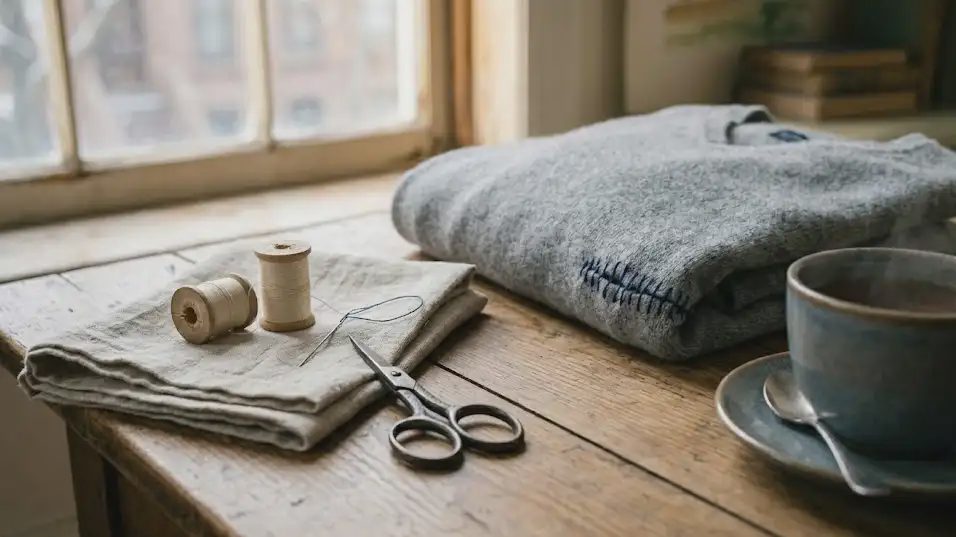
I still have the cashmere sweater. I wear it often. When I put it on, I sometimes run my finger over the small patch of stitches at the elbow. It is not invisible. It is not perfect. But it is evidence — of a Sunday afternoon when I finally sat down, of a small hole that I closed with my own hands, of the quiet and entirely personal truth that mending is not about the garment. It is about the woman who picks up the needle. It is about deciding, stitch by stitch, that you are worth the effort of repair.
My husband tells me that life is like tending flowers: it needs watering every day. Mending is a form of watering. Not just the clothes — the self. The part of the self that has been waiting, folded and patient, for you to believe that it is still worth saving.
Dress for the life you are gently returning to.