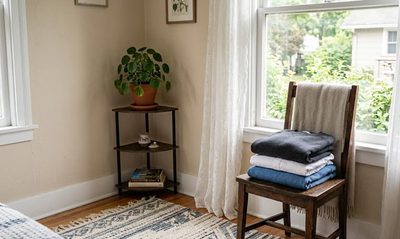
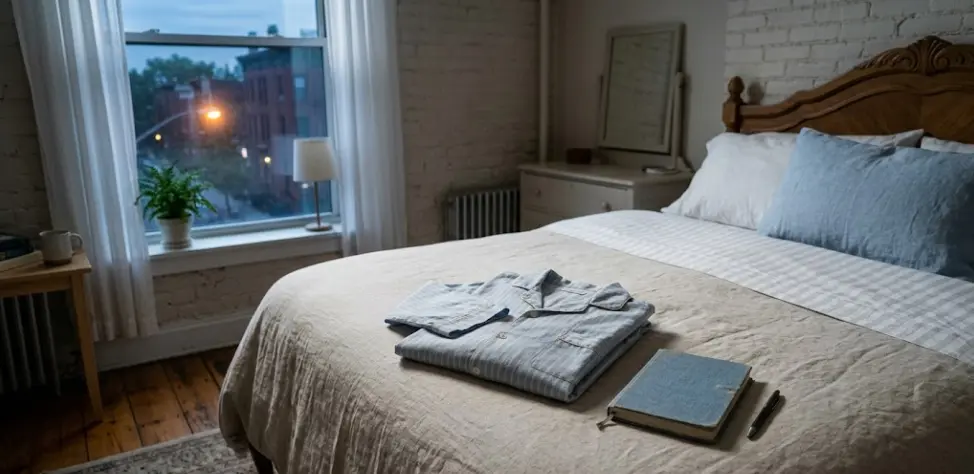
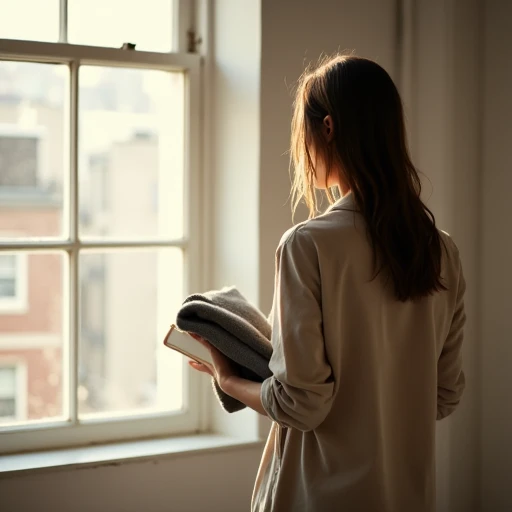
There is a particular hour, in our Brooklyn apartment, when the light shifts. It is not quite dusk anymore and not yet full night — just a softening at the edges of the windows, a kind of blue-grey settling over the buildings across the street. The noise of the neighborhood thins out. The buses on our corner become less frequent. Somewhere in the building above us, a neighbor runs water for a bath. My husband, if he is home, has usually moved to the sofa with a book by then. The kitchen is clean. The flowers on the table have closed slightly, the way tulips do when the temperature drops, folding inward as if keeping a secret.
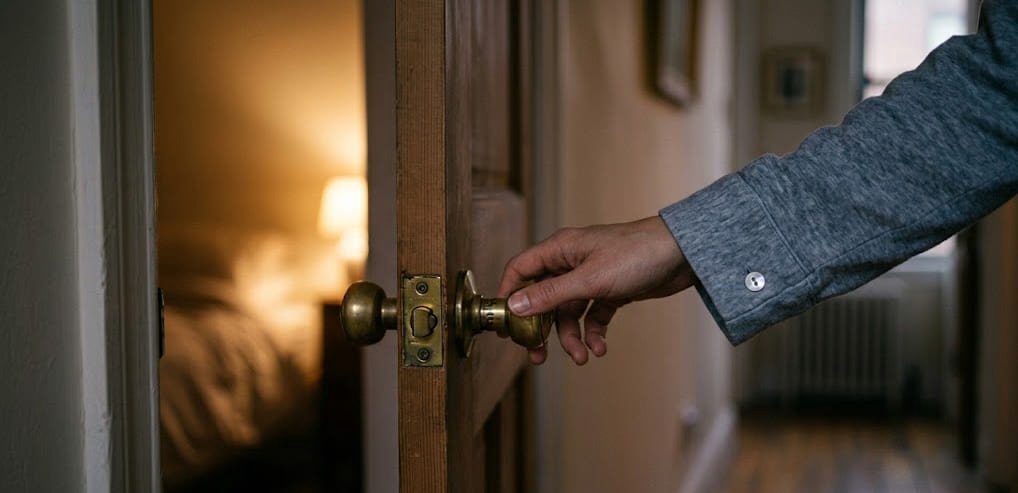
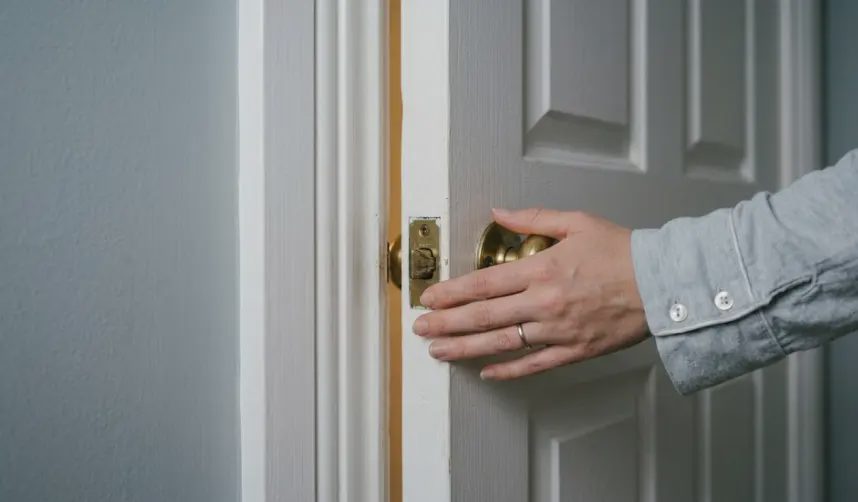
This is the hour when I go to the bedroom and close the door.
Not dramatically. Not with any announcement. Just a quiet click of the latch that says, very gently: the part of the day that belongs to other people is over. What remains is mine.
I have been doing some version of this for about three years now, since shortly after I left Vogue — or, more accurately, since shortly after Vogue and I finished with each other. Before that, my evenings had no shape. They were just the leftover hours after work, messy and exhausted and often spent scrolling through things I did not actually care about, my mind still rotating around the day's tensions. I would fall asleep in whatever I had been wearing since morning, or in something grabbed blindly from a drawer, and I would wake up feeling as though I had never really stopped being on.
The ritual I practice now is not complicated. It involves two things: the deliberate choice of what I wear to sleep, and the writing of exactly one sentence in a small notebook by my bed. That is all. But the effect of these two small acts, repeated over hundreds of nights, has been larger than I expected. It has become, without my quite intending it, the daily practice of letting the day end.
What We Wear to Sleep
I want to talk about pajamas — really talk about them, not as an afterthought or a category of clothing we relegate to the bottom of a drawer — because I believe the way we dress for sleep says something meaningful about how we relate to rest.
For a long time, I did not dress for sleep at all. I wore whatever was softest and most worn-out, things I would not have wanted anyone outside my home to see me in. Old t-shirts from college. Sweatpants with stretched-out knees. The logic, if you could call it that, was that sleep was the part of life where it did not matter what I looked like, because no one was looking. And that is true, as far as it goes. No one is looking.
But I was inhabiting my body. I was the one pulling an old, pilled cotton shirt over my head while my mind still spun with the sentences I wished I had said differently. I was the one climbing into bed in clothes that communicated, wordlessly but persistently: this is the version of me that gets the scraps of the day. This is the version that does not deserve anything more.
That sounds dramatic, I know. But I have come to believe that the small choices we make in private spaces — the way we treat our bodies when no audience is present — are the choices that most accurately reflect our actual relationship with ourselves. If the only clothing I invested real care in was the clothing other people would see, then I was still performing. Even alone, I was performing indifference to my own comfort, my own pleasure, my own worthiness of beauty.
So I made a change, slowly. I bought one pair of proper pajamas — a soft cotton set, nothing extravagant, but beautiful in a quiet way. The shirt had mother-of-pearl buttons. The trousers were cut generously, with a drawstring I could adjust. They were not for anyone else. They were for the woman who had to close her eyes at the end of the day and try to let go of everything she had carried.
And something shifted, that first night. The act of putting them on felt deliberate in a way my old t-shirts never had. It was a small ceremony, a recognizable transition. Now I am entering the rest part of the day. Now I am no longer available to the world.
I have since added a second pair, and a third — one in washed silk for summer, one in a heavier brushed cotton for the cold months when the radiator in our bedroom clanks and hisses and fails to keep the room truly warm. These pajamas are not expensive by Vogue standards, but they are beautiful by mine, and they have held up across dozens of washes. They still feel like a choice rather than a default.
I am not recommending a particular brand. What I am suggesting is something simpler: that the garments we sleep in deserve as much thought as the garments we present to the world — perhaps more, because the woman who wears them has already spent an entire day being brave, being competent, being available, being good. By nightfall, she deserves to be held by something soft.
The Sentence
The second part of the ritual is the notebook.
It is a small thing, small enough to fit in one hand. I bought it at a stationery shop in Cobble Hill the year I left my job, when I was trying to rebuild my inner life from what felt like bare ground. The cover is a dusty blue linen, and the pages are unlined, which matters to me — rules feel wrong, at night. I keep it on the nightstand on my side of the bed, next to a pen that never leaves its spot.
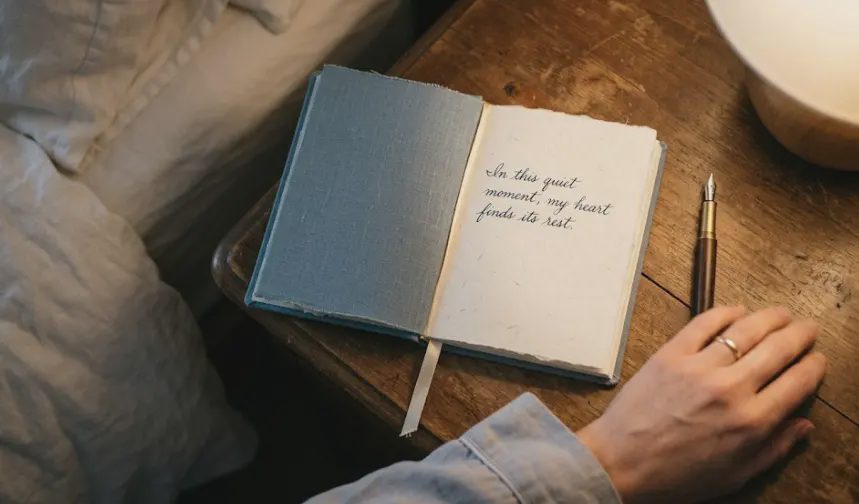
Every night, before I turn out the light, I write one sentence. Just one.
It is not a journal entry. It is not a to-do list or a record of events. It is a single line of gratitude, framed as simply as I can manage. Some nights it is concrete: I am grateful for the way the light hit the kitchen wall this morning. Some nights it is relational: I am grateful my husband laughed at dinner, the real laugh, the one that comes from his chest. Some nights it is very small: I am grateful the coffee was hot and I remembered to drink it slowly.
And some nights, I will be honest with you, it is nearly impossible. Some nights I have to dig through the rubble of a terrible day — a day of sharp emails and sharper self-criticism, a day when I did not feel like a particularly good wife or friend or writer or human — and try to find, somewhere in the wreckage, one thing that was not entirely broken. On those nights, the sentence might be: I am grateful I am still here, trying.
The practice comes from something my husband said to me years ago, during the worst stretch of my burnout. I was lying on the sofa in our old apartment, unable to stop cycling through everything I had done wrong, everything I was failing at, everything that felt permanently broken. He sat down beside me and said, without any particular weight, “You know, life is like tending flowers. It needs watering every day.”
I did not fully understand what he meant at the time. I was too tired to understand much of anything. But the sentence stayed with me, and slowly, over years, I began to see the nightly gratitude sentence as a form of watering. It is a small, consistent act of attention. It does not fix anything. It does not make a terrible day less terrible. What it does is remind me, again and again, that even a hard day contained something that was worth noticing. Something I would have missed, if I had not trained myself to look.
The psychology here is not mine; it belongs to researchers who have studied gratitude practices far more rigorously than I ever will. Studies suggest that regularly writing down things we are grateful for can increase long-term well-being, improve sleep quality, and reduce symptoms of anxiety and depression. I am not citing specific numbers because the numbers are not what matter to me. What matters is the lived experience: the way my mind, over time, has learned to scan the day not just for failures but for small, salvaged beauties. The way I fall asleep now with my attention resting on something gentle, rather than on the sharpest edge of the day.
Letting the Day End
There is a third part to the ritual that I did not plan. It emerged on its own, as the best parts of rituals often do.
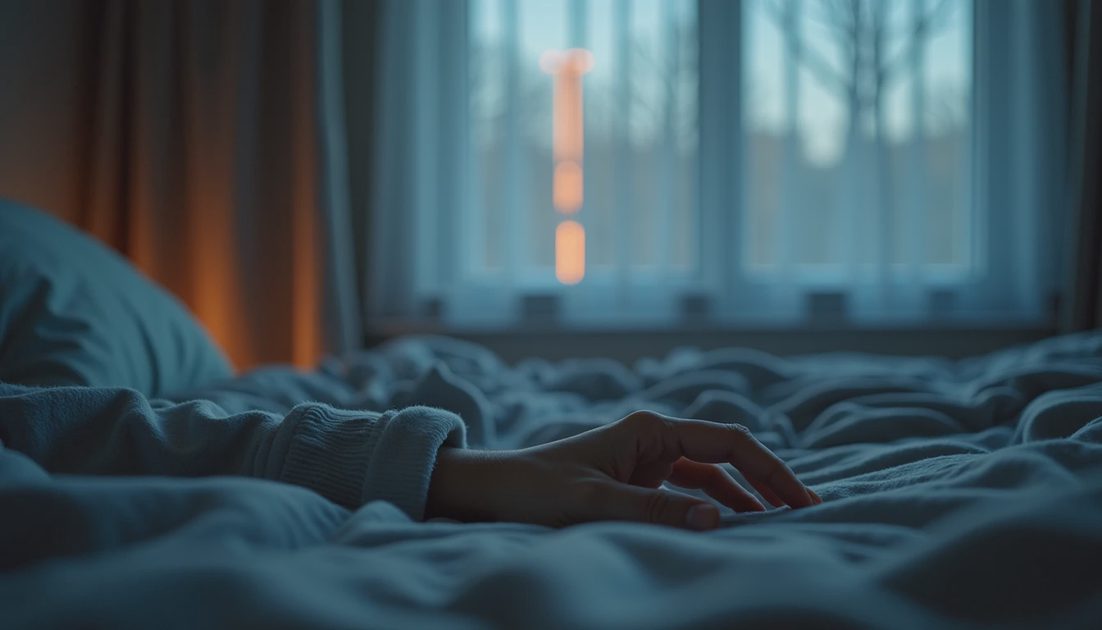
After I close the notebook and set the pen down, I turn off the lamp on my nightstand. The room goes dark except for the faint glow from the streetlight outside, which filters through the curtains in a thin, orangey line. I lie still for a moment. And I say, silently, to the day: You are allowed to end now.
This is not a religious practice for me. It is something closer to a permission slip. I spent so many years — at Vogue, in my twenties, in the long tail of ambition that had no off-switch — feeling that the day was never really done. There was always one more email I could send. One more way I could have performed better. The day bled into the night, and the night bled into the morning, and I woke up already behind, already failing, already exhausted.
Learning to let the day end has been one of the hardest skills I have ever practiced. Harder than learning to fit a sleeve, harder than learning to write a fashion review, harder than learning to walk away from a career I had built with my own two hands. It requires accepting that I did enough, even when enough does not feel like enough. It requires releasing the hope that I can go back and redo the moments I wish had gone differently. It requires trusting that tomorrow will come, and I will try again, and tonight I am allowed to rest.
The pajamas and the sentence and the small, silent permission — together, they form a container for the night. A soft enclosure. A gentle boundary between the woman I had to be today and the woman I am when no one needs anything from me.
What the Ritual Cannot Do
I want to be careful not to make this sound like a cure. It is not.
There are still nights when I lie awake, despite the pajamas and the sentence and the closed door. Nights when the old anxiety circles back, or when grief arrives without an invitation, or when my body simply will not settle. No amount of washed silk and gratitude can permanently banish the harder feelings. I am not sure anything can, and I am not sure anything should. The hard feelings are part of being alive.
What the ritual offers is not escape but accompaniment. It sits beside me in the dark. It says: I know today was difficult. I know you are tired. I am here, the same soft fabric against your skin, the same notebook with its one true sentence, the same breath moving in and out of your lungs. We are still here.
That is the quiet, stubborn persistence of daily practice. It does not demand that you feel better. It simply shows up, night after night, and invites you to do the same.
An Invitation
If any of this resonates with you, I want to offer a small invitation. Not a prescription — I am not in the business of telling women what to do — but an experiment you might try for a few nights and see how it feels.
Choose something beautiful to sleep in. It does not have to be new or expensive. It could be a nightgown you already own but never think to reach for, or a soft cotton set you forgot at the back of the drawer. Choose it deliberately. Put it on as though you were dressing for someone who matters — because you are.
Keep a notebook by your bed. Any notebook. A scrap of paper, a notes app on your phone, whatever is within reach. Before you close your eyes, write one sentence about something — anything — that you are grateful for. It does not have to be profound. It just has to be true.
Then turn off the light. Lie still for a moment. And let the day end.
You do not have to earn the rest. The day is over. You have done enough. Tomorrow will ask everything it asks, and you will meet it then. Tonight, there is nothing more you need to be. Just this: a woman in soft pajamas, with one good sentence in her mind, closing a door gently on the hours that have already passed.
Dress for the life you are gently returning to.