The last app I deleted was Instagram. I remember the exact moment, not because it was dramatic — it wasn't — but because it was so remarkably undramatic for something that had occupied, by my rough estimate, somewhere between ten and fifteen hours of my attention every week for the better part of a decade. My thumb hovered over the icon. The little "x" appeared. I pressed it. The app wobbled for a second, the way they do, and then it was gone. The screen looked suddenly cleaner, like a table cleared after a long meal.
That was seventeen months ago. I have not reinstalled it. I have also not, as certain wellness narratives might suggest, become a completely different person. I did not move to a cabin. I did not take up pottery. I still use my phone for maps and messages and the occasional photograph of something beautiful I want to remember. But I no longer carry a small, endless scroll of other people's outfits, other people's homes, other people's vacations, other people's seemingly effortless lives in the palm of my hand. And my style — the way I dress, the way I think about dressing, the way I feel when I open my closet in the morning — has changed in ways I did not expect and cannot unsee.
What the Apps Were Doing to My Taste
I want to be precise about this, because it is easy to say "social media is bad for you" and leave it at that. Social media was not bad for me in a straightforward way. It was, in fact, quite useful for a time. During my years at Vogue, Instagram was part of the job — a way to see what designers were showing, what editors were wearing, what the industry was talking about before it became a press release. I followed people whose taste I genuinely admired. I saved images of clothes I wanted to remember. I told myself I was curating a visual education.
What I was actually doing, I can see now, was outsourcing my taste to an algorithm.
The mechanism is subtle, which is why it took me years to notice it. You open the app. You see a series of images — a woman in a perfectly oversized blazer, a woman in a particular shade of beige, a woman holding a bag you hadn't known you wanted. You absorb them. You feel a small, pleasurable pull toward each one. You scroll. The algorithm learns. It feeds you more of what you lingered on, more of what you liked, more of what women slightly more polished than you are wearing this season. Over time, the boundary between what you actually like and what the algorithm has taught you to expect from yourself blurs almost completely.
I began to notice this blurring in small ways. I would buy a piece — a pair of shoes, a sweater in a color I didn't usually wear — and later, when I tried to explain to myself why I had wanted it, I couldn't locate a reason that belonged to me. I had seen it on someone whose feed I followed. I had seen it again. I had seen it five, ten, fifteen times, and by the time I bought it, the wanting felt native, but it wasn't. It was borrowed.
This is not a confession of weakness. It is a description of how human attention works in an environment designed to capture and monetize it. The platforms are not neutral conduits of information. They are architectures of persuasion. They are engineered to make certain things seem desirable, and they do it so well that even someone who spent her career studying the mechanics of desire — someone like me — can be persuaded without noticing.
The First Weeks Without the Scroll
The first week after I deleted everything, I felt unmoored. That is the honest word for it. I would pick up my phone out of habit, thumb moving to the spot where Instagram used to be, and find nothing. A blank space. I would put the phone down and pick it up again three minutes later, as if the app might have returned on its own. I was, I realized, deeply uncomfortable with the small, empty moments of my day — the thirty seconds waiting for coffee to brew, the five minutes between finishing dinner and clearing the plates, the idle time on the subway when I used to scroll through images of other women's lives.
I had been using those images to fill something. I am still not entirely sure what. Boredom, perhaps, but also something deeper — a need for input, for stimulation, for the small, regular reassurance that I was keeping up, that I was aware, that I was not falling behind.
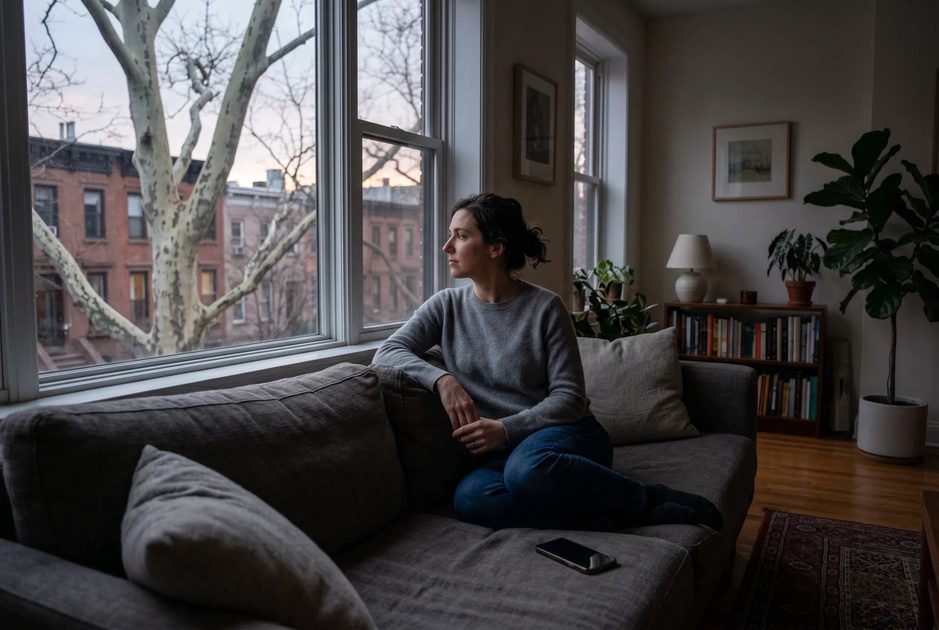
Without the apps, I had to sit with that need instead of feeding it. I had to let the empty moments be empty. I started looking out the window more. I started noticing things I had been scrolling past for years — the way the light hits the building across the street at four o'clock, the particular shade of brown the leaves turn in Brooklyn in late October, the fact that my husband hums slightly when he reads, a sound so quiet I had never registered it before.
My style, during those first weeks, was not better. It was barely anything. I wore the same things over and over — jeans, a sweater, a coat. I didn't think about clothes much. I was too busy adjusting to the quiet.
What Happened to My Closet
And then, slowly, something shifted. I started opening my closet not with the familiar low-grade anxiety of what should I wear to look like I belong in the world I saw on my phone but with a quieter question: what do I actually want to put on my body today?
The difference between those two questions is the difference between performance and presence. The first question asks you to scan an external database of acceptable looks and select one that will pass. The second question asks you to check in with yourself — your temperature, your mood, your sensory needs, your actual life. The first question is exhausting. The second is, it turns out, quite simple.
I started reaching for things that made me feel like myself. Not the self I had been performing online — aspirational, curated, slightly ahead of the trend — but the actual self who lives in a one-bedroom apartment in Brooklyn, who walks to get coffee in the morning, who sits at a desk and writes and sometimes spills tea on her sleeve. I reached for the cashmere sweater I have owned for five years, the one in the grey-blue shade that has never let me down. I reached for my old jeans, the pair that fits exactly right and has faded in places that match my body. I reached for a linen shirt that wrinkles when I breathe, because I like the way it wrinkles.
None of these things were new. None of them were particularly interesting to photograph. None of them had ever appeared on my Instagram feed. I had owned them for years, but I had been seeing them through a filter of insufficiency — they were not enough, not current enough, not statement enough. Without the apps, the filter dissolved. What remained were just clothes that had been waiting for me to trust them.
Shopping Without the Algorithm
The other thing that changed was how I shopped. Before, I shopped reactively. I saw something on social media. I felt the familiar pull. I pursued it. The 72-hour rule helped — I have written about that elsewhere — but even with the rule, the initial impulse was almost always externally generated. Someone else had worn the thing. Someone else had decided it was beautiful. I was responding to their taste, not discovering my own.
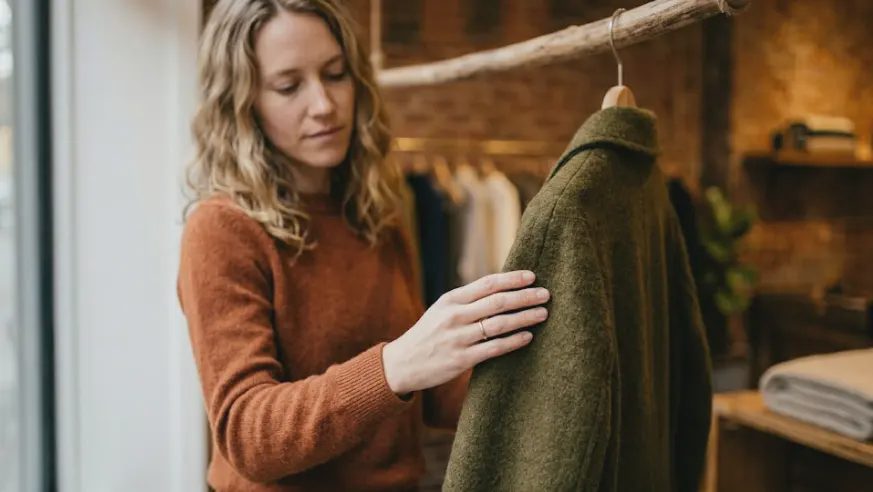
Without the apps, I stopped knowing what was trending. I stopped knowing which bag was the bag of the season. I stopped knowing which color was having a moment. This sounds, I realize, like a disadvantage for someone who writes about fashion. But the opposite was true. Freed from the constant pressure to know what everyone else was wearing, I started noticing what I actually responded to. I would walk past a shop window and see a coat in a shade of deep olive, and I would feel a genuine, unmediated pull toward it — not because I had seen it on five influencers, but because the color reminded me of the moss on a stone wall I had passed in Scotland once, years ago, on a trip with my husband. I would examine the fabric. I would try it on. I would run it through my 72-hour rule. And sometimes I would buy it, and the purchase felt clean — entirely my own.
This is the difference between taste and anxiety. Taste is slow. It comes from somewhere inside you — a memory, a preference, a physical response to a color or a texture or a line. Anxiety is fast. It comes from outside you, from the scroll, from the fear of being left behind. The apps had been feeding my anxiety and calling it taste. When I removed them, the anxiety quieted, and my actual taste — which had been there all along, buried under the noise — had room to breathe.
Who I Was Dressing For
There is a question I now ask myself, and I wish I had asked it years earlier: Who am I dressing for when no one is watching?
Social media creates the illusion that someone is always watching. That is the point of it. That is the architecture. Everything you wear is, potentially, content. Everything you buy is, potentially, a post. The apps turn your entire life into a soft audition for an audience you will never meet, and when you are inside that logic, you cannot see how strange it is. You cannot feel the weight of it. You only feel it when you put the phone down and the audience vanishes and you are left, alone, with a closet full of clothes you chose for people who are not in the room.
I did not realize, until I left, how much of my style was compensatory. I was dressing to prove something — that I still belonged in fashion after leaving Vogue, that I was still relevant, that I still had taste worth noticing. The apps made this performance feel mandatory, because they showed me, every day, exactly how many other women were performing the same thing more successfully.
Without the performance requirement, I started dressing for the only audience that actually matters: the woman who has to inhabit my clothes from morning until night. She has preferences. She has a body with specific needs. She does not care whether her outfit photographs well. She cares whether she can sit comfortably on the subway, whether the fabric breathes, whether she can walk from her apartment to the park and back without thinking about her shoes.
Dressing for her — for me — has been the single greatest liberation of my post-Vogue life.
What I Wear Now
Seventeen months later, my style is quieter. That is the simplest way to describe it. I wear more neutrals, not because neutrals are trending but because I genuinely love them — the way an oat-colored sweater makes my skin look warmer, the way a cream silk shirt catches light, the way a charcoal wool coat feels like a quiet exhale at the end of a long day.
I wear fewer things overall. My closet has contracted. Not because I imposed a minimalist rule on myself, but because I stopped buying things that didn't belong to me. Without the apps pushing newness at me constantly, I am content to wear the same pieces over and over. I have a rotation that works. I do not get bored, because boredom with one's wardrobe is, I have come to believe, often boredom with one's own life projected outward. When the inner world is calm, the outer wardrobe needs very little to feel like enough.
I still love fashion. I still write about it. I still notice beautiful things and feel the old pull of desire. But the desire is cleaner now. It is not desperate. It is not urgent. It is not trying to fill anything. It is just the simple pleasure of seeing something well-made and thinking, That might belong in the life I am building.
An Invitation, Not a Prescription
I am not going to tell you to delete your apps. That would be a prescription, and I do not write prescriptions. I write from experience, and I trust you to know what serves your life and what does not.
What I will say is this: if you have a quiet suspicion that the scroll is doing something to your taste — that it is making your closet feel borrowed, your style feel performative, your mornings feel like a negotiation between what you want and what you think you should want — then you might consider a small experiment. Delete the apps for a week. Not forever. Just a week. See what it feels like to get dressed without an audience. See what you reach for when no one is scrolling past your outfit. See if your own taste, the one that was there before the algorithm found it, is still alive and waiting for you to listen.
You might find, as I did, that it has been waiting a long time.
Dress for the life you are gently returning to.