
I have owned, at various points in my professional life, somewhere between thirty and forty white shirts.
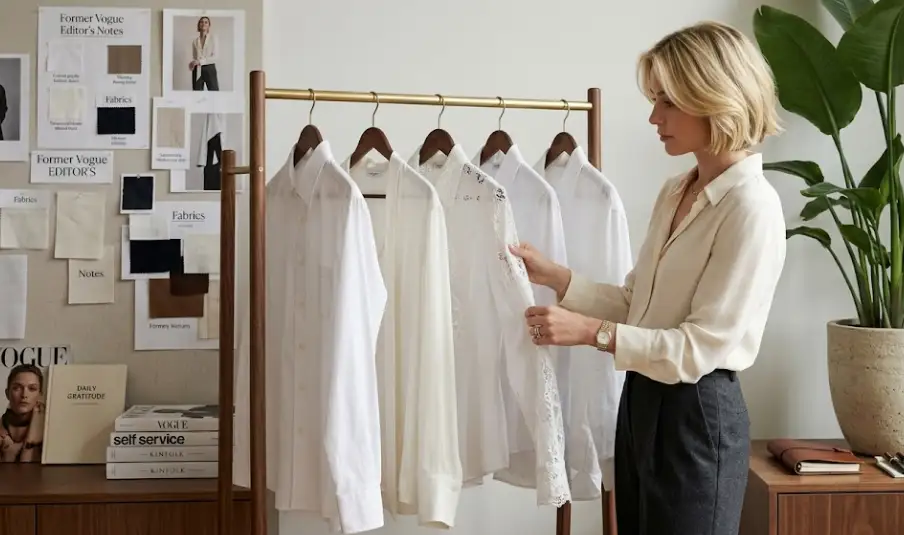
I know this because I spent an afternoon last spring going through the cedar chest at the back of our bedroom closet, the one my husband and I half-jokingly call "the archive," and I found seventeen white shirts folded inside it. Seventeen. Most of them I had forgotten. Several still had tags attached. A few were beautiful in ways that clearly meant something to a version of me that no longer exists — sharp, structured, slightly aggressive in their precision.
I kept two.
The rest I brought to a women's shelter three blocks from our apartment in Brooklyn, and I walked home feeling lighter than I had in years — not from any dramatic act of minimalism, but from the quiet recognition that I had finally learned what I actually needed, and that it was so much less than what I had been accumulating in its place.

This essay is about that lesson. It is also a practical guide, because I believe that beauty and usefulness are not in competition, and that the most honest writing about clothing gives you something you can actually take into a store.
Why the White Shirt Deserves This Conversation
The white shirt is fashion's most enduring foundational piece, and also its most frequently misunderstood one.
It is discussed everywhere — in every "capsule wardrobe" list, every minimalist style guide, every "ten pieces that will change your wardrobe" feature that has ever been published, including several that I edited myself during my years at Vogue. And yet for all of that coverage, most women I know still feel uncertain about it. They own multiple white shirts, none of which feel quite right. Or they have been waiting to find the right one for so long that the category has become quietly fraught.
I understand this intimately. For years, I was one of those women — surrounded by professional knowledge, adjacent to extraordinary clothing, and still unable to land on the white shirt that felt genuinely mine.
Here is what I eventually understood: the difficulty with the white shirt is not a shopping problem. It is a self-knowledge problem. And no amount of industry access or editorial expertise can solve it for you from the outside.
What I can offer you is a framework — built from a decade of professional experience, two years of deliberate unlearning, and the particular clarity that comes from finally having fewer things that mean more.
The Question Before the Shopping
Before I tell you anything about fabric or fit or where to look, I want to ask you something that nobody in a store will ask you, and that most style guides will skip entirely.
What do you actually do in a white shirt?
Not what you imagine doing. Not the aspirational version of your week that you construct when you are browsing online at eleven o'clock on a Tuesday night. What you actually, literally do — in your real mornings, in your real workspace, in your real life.
I ask this because the white shirt that is correct for a woman who works from a home studio in Brooklyn and takes long evening walks and has slow dinners with her husband is categorically different from the white shirt that is correct for a woman who is in client meetings four days a week and travels for work six times a year.
Both women deserve a beautiful white shirt. But they do not deserve the same one.
When I stopped shopping for the white shirt that looked right in an editorial context and started shopping for the white shirt that was right for the life I was actually living, everything became significantly easier. This is the foundational principle of a peaceful wardrobe: dressing for your real life, not your imagined one.
What I Learned About White Shirts From Inside the Industry
There are things you absorb working in fashion editorial that you could not learn any other way — not from magazines, not from shopping, not even from reading very good writing about clothes. One of them is a practical, almost cellular understanding of fabric quality.
After years of handling samples, attending fittings, and sitting in rooms where the difference between a £40 cotton shirt and a £400 one was discussed with genuine analytical rigor, I can tell you the following without hesitation:
The fabric is not a detail. The fabric is the decision.
Everything else — the cut, the collar, the button placement, the way it tucks or doesn't — can be adjusted, tailored, or styled around. The fabric cannot be fixed once you've bought it. And in a white shirt specifically, where there is nothing else happening, no pattern or color to redirect the eye, the quality of the material is entirely exposed.
Here is what to know:
On Fabric: The Hierarchy I Actually Use
Cotton poplin is the classic entry point, and for good reason. A high-quality cotton poplin — look for a thread count above 100, or simply feel for a weight that holds its structure without feeling stiff — is crisp without being harsh, and it maintains its shape through a working day in a way that cheaper cotton cannot manage. This is the fabric for the woman who wants her white shirt to feel quietly authoritative. It presses beautifully. It is honest and straightforward, which is exactly the character I want in a foundational piece.
Silk or silk-cotton blend is for the woman who wants her white shirt to move with her rather than hold its own shape independently. This is the version I reach for most often now — a mid-weight silk that is substantial enough to wear untucked without losing its composure, but fluid enough to feel like a natural extension of the body rather than a structure imposed upon it. Among quiet luxury staples, a good silk white shirt is perhaps the single piece that most reliably elevates everything around it without announcing itself.

Linen belongs in this conversation, but on its own terms. Linen is not a crisp fabric and will never behave like one, and if you buy a linen white shirt expecting the precision of poplin, you will be disappointed. What linen offers instead is something more rare in professional clothing: texture, warmth, and a beautiful imprecision that reads as considered rather than careless. I wear mine on writing days at home, on weekend mornings, on long walks that turn into impromptu dinners. It is not a minimalist essential for every wardrobe, but it may be the right one for yours.
What to avoid: anything described as "easy care," "wrinkle-resistant," or "performance fabric" in the context of a white shirt you intend to love for years. These finishes are chemical treatments applied to lower-quality base fabrics, and they alter the way the shirt feels against your skin in ways that become more noticeable — and more unpleasant — over time. A white shirt that needs ironing is a white shirt made of real material. That is not an inconvenience. That is a feature.
On Fit: The Three Questions Worth Asking
Fit in a white shirt is a conversation between the shirt's construction and your specific body, and no guide — including this one — can tell you exactly where that conversation should land. What I can give you are the three questions I ask myself in every fitting room:
One: Does the shoulder seam sit where my shoulder actually ends?
This is the most reliable indicator of a shirt's fundamental fit. If the seam falls inside your shoulder or droops past it, no amount of tailoring will fully correct the problem. Everything else — the sleeve length, the body width, the overall proportion — flows from this single alignment.
Two: Can I move my arms forward without the back pulling?
A white shirt that restricts your movement is a shirt that will ask for your attention all day. You will feel it every time you reach across a desk, lift a bag, or lean forward in a meeting. That low-level physical distraction accumulates across a working day in ways that are worth taking seriously.
Three: Does the collar lie flat without my assistance?
The collar of a white shirt is its most visible element when you are seated, which is where most of us spend most of our working hours. If it requires pinning, tucking, or continuous adjustment to behave correctly, it is not the right collar for your body. Find one that rests with the quiet confidence you are trying to cultivate everywhere else.
The Brands I Return To, and Why
I want to name names here, because I think the refusal to be specific is one of the less honest habits of fashion writing, and I promised myself when I started this blog that I would not practice it.
These are not sponsorships. They are simply the places I have found quality worth the price, through direct experience.
Margaret Howell makes the white shirt I consider closest to ideal for a slow, considered wardrobe. The cotton is extraordinary. The fit is generous without being shapeless. The detailing is restrained in a way that never dates. It is expensive, and it is worth it.
Cos offers what I consider the best entry point for a foundational wardrobe white shirt at an accessible price — particularly their relaxed cotton poplin styles, which have the proportion and restraint of much more expensive pieces. I have recommended these to friends who are rebuilding their wardrobes after difficult periods and want quality without the investment of a full recovery budget.
Equipment for the silk version. Their silk shirts are properly weighted, not the thin, transparent silk-adjacent fabric that disappoints. The fit runs slightly relaxed, which I prefer.
For something more bespoke, or if you are serious about finding the white shirt you will wear for the next decade, I would encourage you to seek out a local tailor who works with shirting fabric and have one made. The price is more reasonable than most people assume, and the result is a shirt calibrated precisely to your body, your fabric preference, and your life.
How to Know You've Found It
I want to end with something that no product description will tell you, but that I believe is the most important criterion of all.
When you have found your white shirt — the right one, the one that is actually yours — you will not feel the particular low-level anxiety that accompanies a purchase you are trying to talk yourself into. You will not be consulting return policies in your head. You will not be comparing it to three other options you left behind.
You will simply put it on and feel, with quiet certainty, that this is what you were looking for.

It will not transform you. It will not complete you. It will not be the beginning of the wardrobe overhaul that finally makes your mornings easy. Those promises belong to a different kind of fashion writing, one I am no longer in the business of making.
What it will do, on an ordinary Tuesday morning, when you put it on over your best trousers and pour your coffee and sit down to do work that matters to you, is ask absolutely nothing of you.
And that, after everything I know about clothing and the lives we try to build inside it, is the most elegant thing a white shirt can do.
Dress for the life you are gently returning to.