


Last winter, at approximately eleven o’clock on a Tuesday night, I almost bought a coat I did not need.
It was beautiful. I can still see it clearly: a long, sweeping thing in a shade of camel so precise it seemed to hold light. The collar rolled softly away from the throat. The lining was silk. The price was four figures, and I had been staring at it on my phone screen for twenty-three minutes, my thumb hovering over the checkout button, my husband asleep in the next room, the Brooklyn wind pressing against the window.
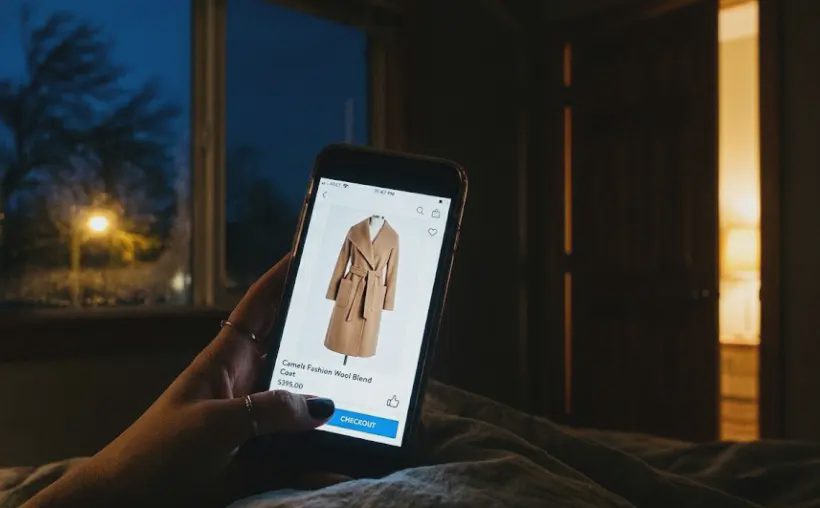
I wanted it. I wanted it in the particular, urgent way that has nothing to do with practicality and everything to do with the fantasy the coat seemed to promise — a version of me who walked differently, who never felt rushed, who moved through the world with the quiet composure of a woman in an expensive camel coat.
I did not buy it. Not because I have extraordinary willpower. I do not. I did not buy it because I have a rule, and the rule did what it was designed to do. It put enough space between the impulse and the purchase for me to remember who I actually am and what I actually wear.
That rule is the 72-hour rule, and it is the single most effective tool I have for making sure the things that enter my wardrobe — and my life — are things I will still want to own a year later, a season later, a Tuesday morning later when there is no fantasy attached, just a woman getting dressed for her actual day.
Where the Impulse Comes From
Before I describe the rule itself, I want to say something about the impulse it is designed to interrupt.
Impulse shopping is not a moral failing. It is not evidence of shallowness or lack of discipline. It is, in large part, a predictable response to a set of conditions that modern commerce has engineered with extraordinary precision. The limited-time offer, the low-stock warning, the influencer endorsement that arrives at precisely the moment you were already feeling a little tender about your appearance — none of this is accidental. It is designed to bypass the deliberative parts of your brain and speak directly to the older, faster, more emotional circuitry that wants what it wants right now.
The neurobiology here is reasonably well understood. Dopamine — the neurotransmitter associated with anticipation and reward — spikes not when we receive the thing we desire, but in the moments of anticipating it. The hunt, the discovery, the near-miss, the checkout: each stage delivers its own small chemical reward. By the time the package arrives, the neurochemical event is already largely over. What remains is often something quieter and more complicated. Sometimes it is satisfaction. Often it is something closer to a hollow feeling — the recognition that the coat did not, in fact, change anything about the woman who unboxed it.
I lived inside this cycle for years. Working at Vogue only intensified it. I was surrounded by beautiful objects, many of them available to me at sample-sale prices or as editorial borrows that sometimes became permanent. The access was extraordinary and the temptation was constant. I bought things I did not need because they were exquisite, because they were discounted, because everyone around me also had them, because I thought they might fill some space in me I did not yet know how to fill on my own.
The 72-hour rule grew out of that period of excess. It was not a theory I read about and adopted. It was a boundary I built, slowly and imperfectly, to protect myself from my own wanting.
How the 72-Hour Rule Works
The mechanics are not complicated. When I find myself wanting to buy something expensive — and by expensive I mean anything that represents a meaningful sum for my budget, not an arbitrary number — I do not buy it. Not yet. I close the browser tab. I walk away from the store. I wait a full 72 hours before I am allowed to return to the decision.
That is the entire rule. Three days. Nothing more elaborate than that.
But the waiting is not empty. Over those 72 hours, I am doing specific things, whether I realize it or not. The rule is not just about delaying gratification. It is about giving my mind time to move from the fast, emotional processing system to the slower, more reflective one. The psychologist Daniel Kahneman’s framework of System 1 and System 2 thinking is useful here, even if he did not apply it specifically to coat purchases. System 1 is fast, associative, and prone to emotional shortcuts. System 2 is slower, more deliberative, and capable of asking: Do I actually need this? What will I give up to have it? Will it still matter to me when the initial excitement fades?
The 72-hour waiting period is essentially a forced handoff from System 1 to System 2. It does not guarantee I will make the right decision. It simply guarantees I will make the decision with the parts of my brain that are capable of long-term thinking.
What I Do During the 72 Hours
The waiting period is not passive. Over time, I have developed a set of quiet practices that fill those 72 hours with useful information. They are not rules within the rule, exactly. They are invitations.
The First 24 Hours: Let the Fantasy Expire
The first day of waiting is the hardest, because the fantasy is still active. I can still see the camel coat in my mind. I can still feel the woman I would be while wearing it.
During this period, I do not try to argue myself out of the purchase. I simply observe. I notice how often the item drifts into my thoughts. I notice the quality of the longing — is it sharp and anxious, or soft and persistent? Sharp, anxious longing is almost always a sign that the purchase is about something other than the object itself. It is about stress, or exhaustion, or a desire to feel a sense of control, or a wish to be seen differently by people who are not actually paying attention.
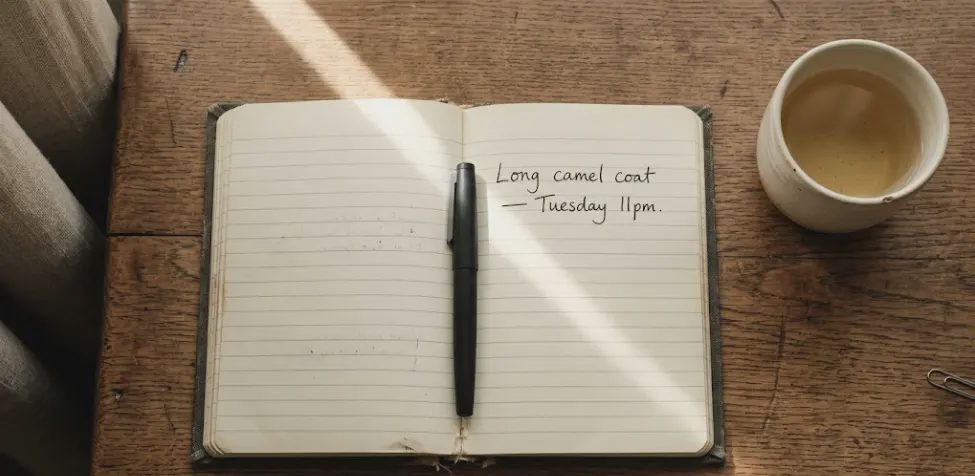
I write the item down in a small notebook I keep for this purpose. The act of writing it — by hand, with a pen — does something interesting. It extracts the desire from the swirling emotional space of my mind and places it onto paper where I can look at it. Often, on the page, it already looks a little less compelling. It is just a coat. It is just a sweater. It is not the answer to anything.
The Second 24 Hours: The Wardrobe Integration Test
On the second day, I go to my actual closet. I open it. I look at the clothes I already own. I ask myself a specific question: If I bought this thing, what would I wear it with? Show me.
This is not a theoretical question. I physically pull out the pieces I would pair it with. I hang them together on a single hook. I assess the gaps. If I cannot put together at least three complete outfits using items I already own, the new piece does not integrate into my existing wardrobe. It will require new purchases to support it. That is a sign, usually, that it belongs to a fantasy version of my life rather than my actual one.

The Third 24 Hours: The Body Check
On the third day, if the desire has survived, I do something that sounds obvious but is easy to skip when you shop primarily online: I imagine the physical sensation of wearing the thing. I close my eyes and imagine the weight of it on my shoulders, the way the fabric meets my skin, the temperature, the restriction or freedom of movement. I ask: Does my body feel like itself in this garment? Does it allow me to exhale? Does any part of it demand constant adjustment?
Garments that demand adjustment are exhausting in a way that accumulates over hours. I have owned enough of them to recognize the pattern. A piece that tugs at the shoulder or gaps at the waist or requires a particular undergarment I do not own will spend most of its life in my closet, not on my body.
If the garment passes all three of these invisible tests — if the longing softens into something steady, if it integrates, if it feels like shelter rather than performance — then, after 72 hours, I allow myself to purchase it.
What the Rule Has Taught Me, Over Years of Practice
I want to be honest about what this rule does and does not do.
It does not prevent me from ever buying things I later regret. I am not perfect at following it. There have been moments of weakness, moments of fatigue, moments when I convinced myself I was making an exception for good reasons and later recognized the familiar hollow feeling in my stomach. The rule is not a guarantee.
What it has done, over years of imperfect practice, is shift the ratio. Before the rule, I regretted perhaps half of my significant clothing purchases within a season. Now I regret very few. The ones that make it through the 72-hour filter are almost always pieces I still own and still wear.
The rule has also changed the quality of my wanting. There is a difference between the hot, urgent, hungry wanting that arrives at eleven o’clock on a Tuesday night and the cool, steady, patient wanting that remains after three days of quiet reflection. The first kind of wanting is about relief. The second is about recognition — the quiet recognition that this thing, whatever it is, might actually belong in the life I am building.
Why 72 Hours, Specifically
I am sometimes asked why the rule specifies 72 hours rather than 24, or 48, or a week. The answer is partly experiential and partly practical.
Twenty-four hours is often not enough. The euphoria of the initial impulse can easily persist through a single sleep cycle. You can wake up the next morning still convinced the camel coat will change your life. It takes a second sleep, I have found, for the fantasy to begin separating from reality.
Forty-eight hours brings you closer, but it can land on a different emotional day — a day that is unusually stressful or unusually joyful, either of which can distort the decision. The third day tends to be more ordinary, more representative of your actual life. It is on the third day, on a Tuesday morning when nothing special is happening, that you can most clearly see a thing for what it is.
A full week would be even more reliably informative, but I have found, practically, that many of the things I consider buying — particularly during sample sales or end-of-season clearances — will not be available a week later. The 72-hour window is a compromise. It is long enough to bypass the impulse but short enough to still be practical for things that are genuinely worth acquiring.
The Relationship Between Money and Peace
I want to close with something that has taken me years to understand.
When I worked at Vogue, I had access to beautiful things at prices that made them feel almost casual. I also had a salary that was not enormous, a high cost of living, and a constant ambient pressure to look a certain way. The gap between what I could access and what I could genuinely afford, without stress, was real. I spent a lot of my twenties quietly anxious about money, even as my closet filled with things that looked, from the outside, like evidence of a very comfortable life.
The 72-hour rule has been, for me, not just a shopping strategy but a practice of financial peace. It has allowed me to step out of the cycle of impulse and regret that characterized so much of my twenties. It has helped me redirect money toward things I genuinely value — a dinner with my husband at a restaurant we love, a weekend away, the feeling of opening my bank account and not immediately feeling my stomach tighten.
There is a phrase I return to often now, one I did not have in my vocabulary during my Vogue years: cost per calm. It is a variation on cost per wear, but it measures something deeper. A garment’s cost per calm is the price divided by the number of times it makes you feel like yourself — grounded, at ease, not thinking about what you are wearing. Some expensive things have an extraordinarily low cost per calm because you reach for them constantly and they never ask anything of you. Some cheap things have an infinite cost per calm because you never wear them at all.
The 72-hour rule is the filter that helps me identify which is which before the money leaves my account.
A Small Practice, Repeated
I no longer almost-buy camel coats at eleven o’clock at night. Not because the wanting has stopped — I suspect it never stops entirely, for anyone who loves beauty — but because I have a practice that holds the wanting gently until it reveals its true nature.
Seventy-two hours is not a very long time. It is approximately the duration of a weekend. It is long enough to read a novel, to take a train to another city, to cook several slow dinners. It is not long enough to change your life, but it is long enough to change a decision. And decisions, accumulated over years, are what change a life.
The next time something beautiful calls to you from a screen, from a store window, from a place that makes your heart beat a little faster — I invite you to do what I do. Close the tab. Walk away. Write it down. Let three ordinary days pass.

Then ask yourself: Is this still here, in the quiet of an ordinary morning? Am I still reaching for it?
If the answer is yes, and it passes the tests I have described, buy it with a clear heart. That is not impulse. That is intention. And intention, practiced long enough, becomes something that looks a great deal like peace.
Dress for the life you are gently returning to.